Fair housing is critical to the fight for a stronger, more equitable, and more prosperous country. The U.S. Department of Housing and Urban Development (HUD) occupies a leadership role in creating thriving, sustainable, inclusive communities and quality affordable homes.2 The federal government has publicly acknowledged the role it has historically played in “systematically declining to invest in communities of color and preventing residents of those communities from accessing the same services and resources as their white counterparts.”3 In contrast, Project 2025 opposes efforts to correct the country’s long history of discriminatory housing practices, and it outlines several tactics to undermine the fair housing rights that the Rev. Martin Luther King Jr. and many others helped to secure.4
Project 2025’s main thesis is that housing assistance and other programs to expand housing access produce “intergenerational poverty traps”5 and “discourage work, marriage, and meaningful paths to upward economic mobility.”6 To implement its policy goals, Project 2025 will reorient HUD away from racial justice and fair housing and reassign the majority of permanent jobs held by long-term career employees to temporary, political appointees.7 Project 2025 claims that “install[ing] motivated and aligned leadership” will empower an administration seeking to dismantle fair housing rights and protections to act more swiftly “with or without congressional action.”8
These policies, which fail to recognize how housing assistance has historically benefited white families to the exclusion of Black families, will dismantle fair housing rights, protections, and programs by:
iThompson v. HUD sought to eradicate the legacy of decades of government-sponsored racial segregation in Baltimore, Maryland. The litigation led to establishing the Baltimore Housing Mobility Program, through which families can choose to move to mixed-income neighborhoods with better access to employment and educational opportunities.
Project 2025 will block the federal government from tracking racial disparities and discrimination in housing. Project 2025 suggests that all forms of racial classification, including the collection of data on racial groups, are inherently racist, and will therefore suspend all government efforts to gather evidence of discrimination.9 It will also end fair housing testing, which the government uses to identify bias and discrimination in the housing market. This testing typically involves individuals posing as prospective renters or buyers to determine whether housing providers are complying with fair housing laws.10
Project 2025 will transfer all of HUD’s enforcement obligations to state and local governments, creating a patchwork system of independent fair housing enforcement and ending HUD’s ability to effectively enforce federal fair housing laws.11 Given the anti-civil rights positions certain states and localities have taken, both historically and in recent years, this shift will subject countless families and individuals to housing discrimination.ii Project 2025 also encourages local governments to invest exclusively in single-family zoning, rather than also investing in multi-family zoning. Single-family zoning has a long history of being racially motivated to exclude Black families from white neighborhoods.12 This proposal poses a direct threat to Black communities and will further restrict housing supply during a nationwide housing crisis, making it more difficult for lower-income families to live in low-poverty, well-resourced neighborhoods.
Taken together, these proposals to weaken HUD’s authority and relegate the enforcement of fair housing protections to the discretion of state and local governments will strip Black communities of their civil rights under federal law. For instance, states hostile to civil rights may expand the use of “crime-free” ordinances, which encourage or require private landlords to exclude or evict tenants who have had encounters with the criminal legal system even if they present no danger to others, thereby facilitating racial discrimination. These ordinances have the purported goal of stemming crime in rental housing, but in practice, they systematically exclude Black people from housing and promote racial segregation because of bias and discrimination in the criminal legal system.13 Such policies treat housing applicants and tenants as suspects, blurring the line between housing decisions and policing.
ii Project 2025’s proposal goes well beyond HUD’s partnership with and oversight of certain states and localities that participate in HUD’s Fair Housing Assistance Program. See https://www.hud.gov/program_offices/fair_housing_equal_opp/partners/FHAP
Project 2025 will limit the reach of HUD’s rental assistance programs to as few households as possible, despite the nation’s housing affordability crisis.14 It will achieve this through: 1) reducing investments in housing assistance, with drastic cuts to subsidized housing and voucher programs;15 2) adding more requirements to applications for rental assistance;16 and 3) ending housing subsidies even to low-income households who comply with all program requirements.17
Cutting housing assistance programs will have a devastating impact on the Black people and other traditionally marginalized groups that these programs serve. The majority of Black households rent rather than own their home (fifty-six percent vs. forty-four percent), and Black households are substantially overrepresented in subsidized housing.18 A growing body of research documents that Black renter households and neighborhoods with higher percentages of Black renters face disproportionately high rates of eviction filings, including for no-fault evictions.19 As a result, Black renter households are again likely to bear the brunt of the consequences from Project 2025’s proposals.
The largest subsidized housing program, the “Section 8” Housing Choice Voucher program, is a crucial anchor for millions of low-income families, providing secure homes in which they can grow and thrive. There is already an insufficient supply of vouchers to meet the overwhelming demand.20 The federal government should expand housing assistance to ensure that every extremely low-income household can access affordable housing,21 not cut housing assistance as Project 2025 proposes.
Project 2025’s counterproductive proposals will perpetuate homelessness for Black and Indigenous people, who experience homelessness at higher rates than white people largely due to longstanding structural racism.22
Black people represent less than fourteen percent of the general population, but account for thirty-seven percent of people experiencing homelessness and more than fifty percent of homeless families with children.23 The lack of affordable housing creates additional obstacles for families and individuals who are experiencing homelessness and are trying to get back on their feet. Housing is foundational to—not the reward for—health, recovery, and economic success. Tactics that exacerbate homelessness will impact Black communities most severely.
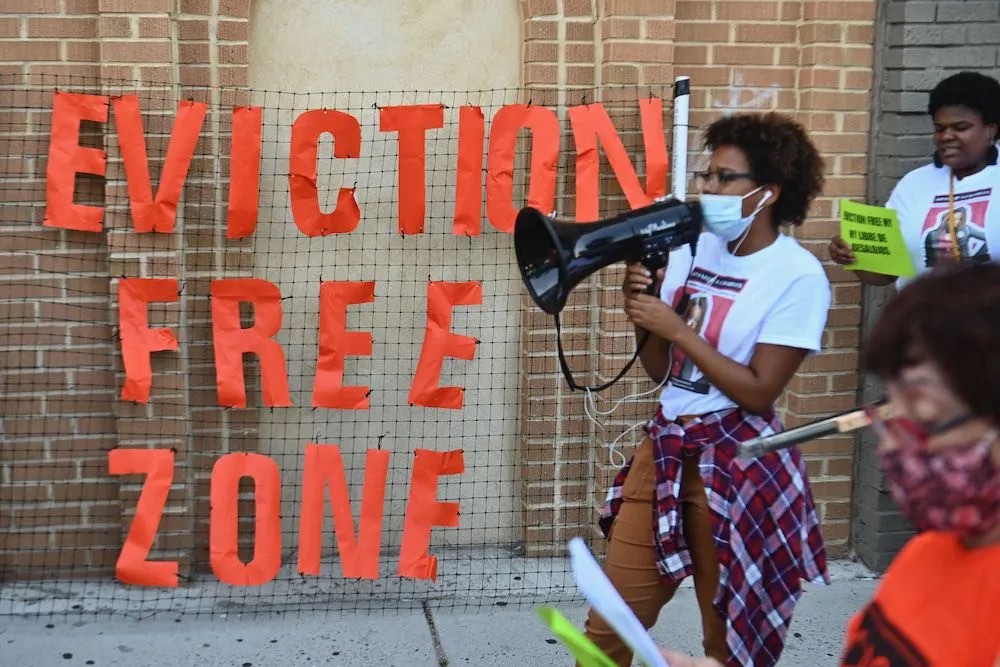
New York state is experiencing a housing crisis, and it continues to get worse. This especially impacts Black renters, particularly Black women. Our research provides further evidence of this disparity and and it calls critical attention to the urgent need for a good cause eviction protection law to help address this racialized inequity.
Despite noting that “homeownership remains the most accessible way to build generational wealth for millions of Americans,”24 Project 2025 will restrict access to homeownership by increasing mortgage insurance premiums and decreasing down-payment assistance.25 This will make it harder for first-time homebuyers, many of whom are Black, to achieve the dream of homeownership.26
Decades of housing discrimination have produced a stark racial homeownership gap in the United States, where Black households are significantly less likely to own their homes than white households.28 Because homeownership is one of the most common ways for families to build wealth, this pronounced racial homeownership gap also contributes to the racial wealth gap and serves as a longstanding barrier to wealth generation and economic prosperity for Black families.29 Efforts to weaken homeownership and equal credit opportunities for Black families will lead to decreased wealth and well-being while exacerbating economic inequality.
Fair housing is a hard-won right achieved by civil rights advocates and guaranteed under federal law. Housing policies and programs like fair housing enforcement, rental assistance, and homeownership assistance are necessary for Black households to access safe housing, build wealth, safeguard their health, and live productive and fulfilling lives. Project 2025 will undermine efforts to create thriving, integrated neighborhoods and a more just society. Policymakers and advocates must resist proposals to block people of color, especially low-income Black people, from accessing safe and stable housing. Instead, they should continue to fight for fair housing so that all people—regardless of race, color, birthplace, gender, religion, family status, or disability status—have equal access to quality housing.
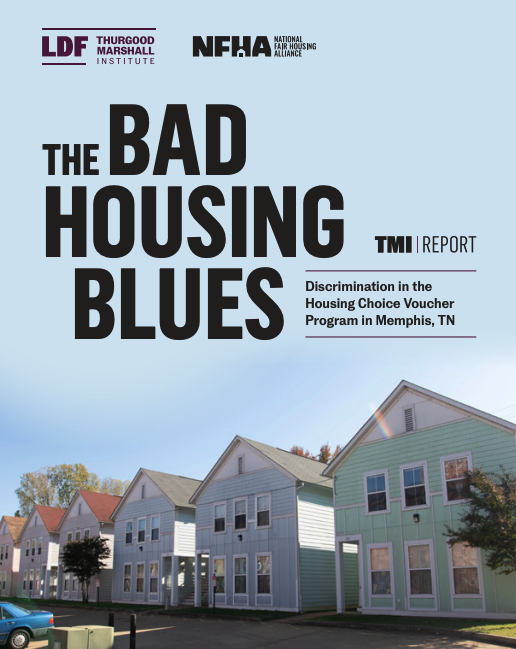
Bad Housing Blues looks at economic and racial discrimination in housing, investigating the local rental market, assessing attitudes, and identifying policies and practices that impede the ability of voucher holders to secure safe and affordable housing. The report found barriers to securing safe and affordable housing for Housing Choice Voucher (HCV) holders included “No Section 8” policies; Housing Choice Voucher tenant quotas; steering or restricting access to housing; and employment, minimum income, and payment requirements.
Every person deserves safe, affordable, and quality housing. To that end, LDF works to protect and expand equal access to housing for Black people and to combat the lasting effects of historic and ongoing housing discrimination and segregation. For decades, housing in the United States has been shaped by anti-Black discriminatory policies and practices, including redlining, the placement of housing for Black families near environmental hazards, the withholding of public services, bias and discrimination in lending and appraisals, and state-sanctioned violent resistance when Black families attempt to move into white neighborhoods.30 This foundation of structural racism in the housing sector has resulted in widespread racial residential segregation and has severely impacted Black families’ ability to secure and maintain safe and affordable housing in well-resourced neighborhoods. To realize the vision of equal access to quality housing for all, LDF is tackling present-day housing discrimination and the legacy of past discrimination by expanding access to quality housing, defending everyone’s right to choose where they live, advancing equal housing and credit opportunities, and closing the racial homeownership and wealth gaps. Protecting and expanding equal access to housing while fighting the lasting effects of housing discrimination requires robust fair housing regulations and implementation guidance; ongoing investments in housing assistance, neighborhood resources, infrastructure, and the local organizations that address housing discrimination;iii and the expertise of a nonpartisan federal workforce.
iii See https://www.hud.gov/program_offices/fair_housing_equal_opp/partners/FHIP (describing how fair housing organizations and other nonprofits receive funding through HUD’s Fair Housing Initiatives Program [FHIP] to assist people who believe they have been victims of housing discrimination).