
Research and Operations Associate

Senior Researcher and Statistician
Everyone deserves a system of public safety that respects their humanity and dignity.2NAACP Legal Def. Fund, Framework for Public Safety, https://www.naacpldf.org/framework-for-public-safety/ (last visited Dec. 1, 2025). Yet, many Black people repeatedly endure invasive police encounters, during which officers treat them with suspicion and subject them to searches, violence, and, in some cases, deadly force.
During the public testimonyiThe Legal Defense Fund expressed public support for the passage of the How Many Stops Act, and a representative of the Legal Defense Fund testified in support of the How Many Stops Act at the March 27, 2023, New York City Council hearing. excerpted above, Ibrahim X, a Black man from Brooklyn, described the many times police encounters have interrupted his life. Each year, the New York City Police Department (NYPD) conducts millions of investigative encountersiiAs discussed in the “Definitions of Police Investigative Encounters in New York” call-out box below, the NYPD Patrol Guide labels certain interactions as “encounters,” rather than “stops,” because by law, people are free to leave and end the encounter. like these. Each encounter has the potential to escalate and become intimidating, traumatic, dehumanizing, and even deadly. The person being approached by police may not know whether they have the right to leave, or feel comfortable doing so, because of the implicit and explicit threat of punishment and violence that police officers pose.
Prior to July 2024, the vast majority of police investigative encounters in New York City went unreported.3Press Release, Ctr. for Const. Rights, New Monitor’s Report Shows Vast Underreporting of Stops by NYPD (Oct. 7, 2024), https://ccrjustice.org/home/press-center/press-releases/new-monitor-s-report-shows-vast-underreporting-stops-nypd. The NYPD was only required to release public data on Terry stops, which require an officer to have reasonable suspicion connecting a particular person to a particular crime or probable cause that a person has committed a civil traffic violation.4Civilian Compl. Rev. Bd., Stop, Question and Frisk, City of N.Y., https://www.nyc.gov/site/ccrb/investigations/stop-question-and-frisk.page (last visited Dec. 1, 2025). Community mobilization led the New York City Council to pass the How Many Stops Act, which went into effect in July 2024. The law now requires the NYPD to report data on all investigative encounters, including those that do not require reasonable suspicion.5Stephen Koppel & Michael Rempel, First Look at the How Many Stops Act Data (2025), https://datacollaborativeforjustice.org/wp-content/uploads/2025/02/How_Many_Stops_Act_Final.pdf. With this novel data, communities can begin to understand the scale and racialized nature of police encounters in New York City.
In this Brief, the Thurgood Marshall Institute (TMI) analyzed the first year of data publicly released by the NYPD as mandated by the How Many Stops Act,6N.Y. Police Dep’t, Investigative Encounters, City of N.Y., https://www.nyc.gov/site/nypd/stats/reports-analysis/investigative-encounters.page (last visited Dec. 1, 2025). covering the period of July 2024 through June 2025 for Level 1, Level 2, and Level 3 encounters (see below for a description of each encounter level and the associated legal standard). To view the data, the analytic code, and a description of the methods used for this analysis, visit TMI’s GitHub repository.
Officers documented ninety-eight percent of police encounters as the lowest level (Level 1).
Black people were significantly more likely than white people to be approached by police at all levels of encounters.
Precincts with a higher percentage of Black residents had significantly higher police encounter rates.
Precincts with a higher percentage of white residents had significantly higher racial disparities in police encounter rates, where Black people in those neighborhoods were much more likely than white people to be approached by police.
This Brief first provides background information on the history of police investigative encounters and the racially discriminatory nature of such interactions in New York City, as well as on community advocacy, proposed bills, and litigation to address racially discriminatory practices. The Brief then presents the results of TMI’s analysis of data made available under the How Many Stops Act.
The next section focuses on the potential consequences of racialized police encounters in New York City. Racial disparities pervade the United States’ criminal legal system, from police contact to arrests to incarceration,7Vera Inst., An Unjust Burden: The Disparate Treatment of Black Americans in the Criminal Justice System (2018), https://www.vera.org/publications/for-the-record-unjust-burden. and TMI’s analysis shows that low-level investigative encounters in New York City are no exception. These interactions drive racialized contact with NYPD officers and can ensnare Black New Yorkers in systems of surveillance and incarceration, with notable impacts on their health and safety.8Alyasah A. Sewell, Kevin A. Jefferson, & Hedwig Lee, Living under surveillance: Gender, psychological distress, and stop-question-and-frisk policing in New York City, 159 Soc. Sci. & Med. 1 (2016), https://www.sciencedirect.com/science/article/abs/pii/S0277953616301988?via%3Dihub; Abigail A. Sewell & Kevin A. Jefferson, Collateral Damage: The Health Effects of Invasive Police Encounters in New York City, 93 J. Urb. Health 42 (2016), https://link.springer.com/article/10.1007/s11524-015-0016-7.
Finally, at a time when many policymakers seek to erase demographic data and other key governmental data,9Stevie Marvin & Adewale A. Maye, How Trump’s erasure of environmental data is endangering communities of color, Econ. Pol’y Inst. (Apr. 22, 2025), https://www.epi.org/blog/how-trumps-erasure-of-environmental-data-is-endangering-communities-of-color/; Kelly Hooper, CMMI to scrap data collection on race, gender, Politico (Feb. 11, 2025), https://subscriber.politicopro.com/article/2025/02/cmmi-to-scrap-data-collection-on-race-gender-00203659; E.D. Cauchi, Justice Department shuts down federal law enforcement misconduct tracker, CBS News (Feb. 21, 2025), https://www.cbsnews.com/news/justice-department-shuts-down-federal-law-enforcement-misconduct-tracker/; Ethan Corey, Trump DOJ Erases Trans People from Crime Data Surveys, The Appeal (May 5, 2025), https://theappeal.org/trump-doj-erases-trans-people-from-crime-data-surveys/; Thurgood Marshall Inst., Risks to Voting Rights, Democracy, and Black Political Power, NAACP Legal Def. Fund, https://tminstituteldf.org/threats-to-voting-rights-project-2025/ (last accessed Feb. 9, 2026). this Brief concludes with a discussion of the importance of data transparency and advocacy recommendations to defend the public’s indispensable right to information.
Ultimately, TMI’s analysis demonstrates the light that can be shed on the nature of law enforcement when officers document their activity and the public can access such data. As explained in this Brief, officers categorize most police encounters as low-level, and Black New Yorkers face frequent police intrusion in their daily lives. Data transparency about these encounters improves understanding of police-civilian interactions and how public resources are used.
Level 1 encounters are “requests for information” that do not require any suspicion of criminal activity. The officer may not ask accusatory questions but may ask for information such as the person’s name and identification. An officer may not create a situation in which a reasonable person would not feel free to leave. The individual has the right to refuse to engage with the officer and walk away.11N.Y.C. Police Dep’t, Patrol Guide Proc. No. 212-11, Investigative Encounters: Requests for Information, Common Law Right of Inquiry and Level 3 Stops, City of N.Y. (Oct. 15, 2016), https://www.nyc.gov/html/nypd/downloads/pdf/analysis_and_planning/212-11.pdf; People v. Boulware, 515 N.Y.S.2d 238 (N.Y. App. Div. 1987); People v. Thomas, 792 N.Y.S.2d 472 (N.Y. App. Div. 2005); People v. Reyes, 605 N.Y.S.2d 262, 263 (N.Y. App. Div. 1993).
See People v. Thomas
19 A.D.3d 32, 38, 792 N.Y.S. 472 (N.Y. App. Div. 2005)
Level 2 encounters are considered “common law rights of inquiry” used when an officer has basis to believe that criminal activity has occurred but not enough information to lawfully “stop” the person (Level 3). An officer may not create a situation in which a reasonable person would not feel free to leave. The person has the legal right to refuse to engage with the officer and walk away. Doing so should not raise the level of suspicion. During a right of inquiry, the officer may ask an individual accusatory questions.12N.Y.C. Police Dep’t, supra note 11; People v. DeBour, 259 N.Y.S.2d 170 (N.Y. App. Div. 1965); in re Shakir J., 990 N.Y.S.2d 85 (N.Y. App. Div. 2014); People v. Hill, 898 N.Y.S.2d 553 (N.Y. App. Div. 2010); People v. Fernandez, 928 N.Y.S.2d 293 (N.Y. App. Div. 2011).
See People v. Fernandez
87 A.D.3d 474, 928 N.Y.S.2d 293 (N.Y. App. Div. 2011)
Level 3 stops require an officer to have individualized reasonable suspicion, based on specific facts, that the person stopped has committed, is committing, or is about to commit a criminal act. During a Level 3 stop (also known as a Terry stop), the officer may ask accusatory questions and briefly detain the individual to confirm or dispel their suspicion about their involvement in a crime. Officers can detain someone and prevent them from leaving the scene only during a Level 3 stop.13Communities United for Police Reform, How Many Stops Act Fact Sheet (Jan. 5, 2023), https://www.changethenypd.org/files/docs/final_hmsa_fact_sheet_01.5.23.pdf; Terry v. Ohio, 392 U.S. 1 (1968); People v. DeBour, 259 N.Y.S.2d at 170.
See Terry v. Ohio
392 US 1 (1968)
The NYPD Patrol Guide labels Level 1 and Level 2 interactions as “encounters,” rather than “stops,” because by law, people are free to leave and end the encounter. However, the implicit and explicit threat of repercussions when a police officer approaches a person can blur the lines between Level 1, 2, and 3 encounters, making them indistinguishable for the person being approached. Furthermore, the person is often not made aware of whether they are free to leave.14NYPD Monitor, Know Your Rights, https://www.nypdmonitor.org/know-your-rights/ (last visited Dec. 1, 2025).
The validity of the data analyzed in this Brief depends on complete and accurate reporting of investigative encounters by NYPD officers, as it is a product of officer self-reporting. Analyzing this dataset requires operating under the assumption that the data reflect the officers’ actual conduct, and that their conduct aligns with the requisite level of suspicion. The data analysis in this Brief reflects this limitation.
Beginning in the 1950s, cities across the United States implemented a new policing strategy characterized by police officers flooding neighborhoods deemed “high crime” and stopping, questioning, and searching a large number of people based on vague and unreliable criteria.16Sam McCann, What is Stop-and-Frisk?, Vera Inst. (Feb. 21, 2025), https://www.vera.org/news/what-is-stop-and-frisk; Alex Elkins, The Origins of Stop-and-Frisk, Jacobin (May 2015), https://jacobin.com/2015/05/stop-and-frisk-dragnet-ferguson-baltimore/. Under this strategy, known as stop-and-frisk policing, officers disproportionately stopped Black and Latinx people, often without probable cause.17See sources cited supra note 16.
As stop-and-frisk policing proliferated in New York City, data revealed that police conducted stops and searches in a racially discriminatory manner.18Vera Inst., supra note 16. In 2011, at the height of New York City’s stop-and-frisk practice, NYPD officers documented more than 685,000 Level 3 stops.19NYCLU, Stop-and-Frisk Data (May 27, 2025), https://www.nyclu.org/data/stop-and-frisk-data. More than eighty percent of those stopped were Black or Latinx, despite these groups representing less than half of the New York City population.20Abhery Das & Tim A. Bruckner, New York City’s Stop, Question, and Frisk Policy and Psychiatric Emergencies among Black Americans, 100 J. Urb. Health 255 (2023), https://pmc.ncbi.nlm.nih.gov/articles/PMC10160307/. These disparities led to litigation and community advocacy efforts to curtail the practice.21NYCLU, A Closer Look at Stop-and-Frisk in NYC (May 27, 2025), https://www.nyclu.org/data/closer-look-stop-and-frisk-nyc (last visited Feb. 10, 2026); David A. Harris, Across The Hudson: Taking The Stop And Frisk Debate Beyond New York City, 16 N.Y.C. J. Legis. & Pub. Pol’y 853, 866 (2013), https://nyujlpp.org/wp-content/uploads/2014/01/Harris-Across-the-Hudson-16nyujlpp853.pdf; Renée McDonald Hutchins, Stop Terry: Reasonable Suspicion, Race, and a Proposal to Limit Terry Stops, 16 N.Y.C. J. Legis. & Pub. Pol’y 883, 901–907 (2013), https://digitalcommons.law.umaryland.edu/cgi/viewcontent.cgi?referer=&httpsredir=1&article=2405&context=fac_pubs (last visited Feb, 10, 2026).
In 2013, a federal class action lawsuit, Floyd, et al. v. City of New York et al., successfully challenged the NYPD’s stop-and-frisk practices as unconstitutional because they lacked the requisite justification and were racially discriminatory.22Floyd v. City of New York, 770 F.3d 1051 (2d Cir. 2014); see Ctr. for Constitutional Rgts., Floyd, et al. v. City of New York, et al., https://ccrjustice.org/home/what-we-do/our-cases/floyd-et-al-v-city-new-york-et-al (last visited Dec. 5, 2025). A federal judge ruled that the practices violated the Fourth and Fourteenth Amendments to the U.S. Constitution and appointed an independent monitor to oversee court-ordered reforms.23Floyd, 770 F.3d 1051.iiiThe Joint Remedial Process recommendations include: the creation of permanent feedback structures regarding officer conduct; a monthly NYPD discipline report; a pilot program to activate body-worn cameras during lower-level encounters; a public education campaign to inform residents about their rights during police encounters; and seven additional reforms. The full list of reforms can be found here: https://www.jamsadr.com/files/uploads/documents/articles/belen-new-york-city-joint-remedial-process-may-2018.pdf. At least three of the recommendations have been ordered by the court (officer feedback structures, body-worn cameras, and the documentation of Level 1 and Level 2 encounters), and others remain to be considered. Source: https://ccrjustice.org/home/get-involved/tools-resources/fact-sheets-and-faqs/timeline-floyd-v-city-new-york. The Legal Defense Fund (LDF) and co-counsel represented plaintiffs in a related class action lawsuit, Davis, et al. v. City of New York, et al., which challenged the NYPD’s stops and arrests for trespass in public housing developments as lacking sufficient justification and being racially discriminatory.24NAACP Legal Def. Fund, Case: Davis v. City of New York, https://www.naacpldf.org/case-issue/davis-v-city-new-york/ (last visited Dec. 5, 2025). The settlement reached in the Davis case in 2015 was incorporated into the court-ordered Floyd case monitorship.
Additionally, in November 2013, Bill de Blasio won the New York City mayoral election with a promise to “end the era of stop-and-frisk.”25Joel Rose, De Blasio Drops Appeal Of ‘Stop And Frisk’, NPR (Jan. 30, 2014), https://www.npr.org/2014/01/30/268964572/de-blasio-drops-appeal-of-stop-and-frisk. Months earlier, a vast network of community organizations throughout the city had persuaded the New York City Council to pass the Community Safety Act.26N.Y. City Council, Int. No. 1080-2013, L. No. 2013/071 (2013), https://legistar.council.nyc.gov/LegislationDetail.aspx?ID=1444267&GUID=BCB20F20-50EF-4E9B-8919-C51E15182DBF; see Communities United for Police Reform, The Community Safety Act, https://www.changethenypd.org/community-safety-act (last visited Dec. 5, 2025). The Community Safety Act included provisions that authorized the NYC Department of Investigation to review the NYPD’s policies and procedures, and it established an enforcement mechanism to file suit against NYPD officers engaging in racial profiling.27Press Release, NYCLU, NYCLU Applauds NY City Council’s Passage of the Community Safety Act (June 27, 2013), https://www.nyclu.org/press-release/nyclu-applauds-ny-city-councils-passage-community-safety-act.
Following years of NYC community mobilization and strategic litigation, the annual number of Level 3 stops recorded by the NYPD in 2019ivThe volume of stops continued to decline in 2020 and 2021, dropping below 9,000 stops in 2021. This was likely due in part to the COVID-19 pandemic and underreporting. Source: New York City Police Department, https://www.nyc.gov/site/nypd/stats/reports-analysis/stopfrisk.page and Center for Constitutional Rights, https://ccrjustice.org/home/press-center/press-releases/new-monitor-s-report-shows-vast-underreporting-stops-nypd. dropped sharply to around 13,500.28Surina Venkat, NYPD Stop-and-Frisks Soared in 2024, N.Y. State Focus (Apr. 2, 2025), https://nysfocus.com/2025/04/02/nypd-stop-and-frisk-eric-adams. While the overall number of recorded stops decreased, racial disparities in recorded stops remained the same.29Mylan Denerstein, Twentieth Report of the Independent Monitor, Indep. Monitor of the N.Y. Police Dep’t
(Apr. 11, 2024), https://www.nypdmonitor.org/wp-content/uploads/2024/04/2024.04.11-927-1-Twentieth-Report.pdf. The number of reported Level 3 stops rose again under Mayor Eric Adams, with more than 25,000 such stops recorded in 2024.30Surina Venkat, NYPD Stop-and-Frisks Surged Again in 2024 Under Adams, The City (Apr. 2, 2025), https://www.thecity.nyc/2025/04/02/nypd-stop-and-frisks-2024-surge-eric-adams/.
Prior to July 2024, the public received only data on these Level 3 stops, in which the person stopped was not legally free to leave. However, NYPD officers also conduct Level 1 and Level 2 investigative encounters, where the officer is not required to have reasonable suspicion and the person stopped is legally free to leave, as documented by the officer. Until recently, the public had no information on these lower-level encounters.
As data on Level 3 stops by the NYPD revealed the racially discriminatory nature of these stops, advocates sought similar transparency with respect to all investigative encounters, including lower-level encounters.31Stipulation of Settlement and Order, Davis v. City of New York, No. 1:10-cv-00699-SAS-HBP (S.D.N.Y. Jan. 7, 2015), Dkt. No. 322-1. A coalition of organizations led by Communities United for Police Reform urged the New York City Council to pass the How Many Stops Act, composed of Intro. 586 and Intro. 538.32N.Y. City Council, Int. No. 0586-2022, L. No. 2024/043 (2024), https://legistar.council.nyc.gov/LegislationDetail.aspx?ID=5725293&GUID=C4781093-1108-4E04-848D-473B2E47BD2E; N.Y. City Council, Int. No. 0538-2022, L. No. 2024/020 (2024), https://legistar.council.nyc.gov/LegislationDetail.aspx?ID=5698236&GUID=7CE14BDB-291C-475E-8260-0DC90FDF1E76; Campaign Zero, A Step Forward in Transparency: The Passage of NYC’s “How Many Stops Act” (Jan. 3, 2024), https://campaignzero.org/a-step-forward-in-transparency-the-passage-of-nycs-how-many-stops-act/; Communities United for Police Reform, How Many Stops Act, https://www.changethenypd.org/HowManyStopsAct (last visited Dec. 5, 2025). On January 30, 2024, after Mayor Adams vetoed the How Many Stops Act, the New York City Council voted to override the mayor’s veto.33N.Y. City Council, Int. No. 0586-2022, supra note 32; N.Y. City Council, Int. No. 0538-2022, supra note 32; Get The Facts On The How Many Stops Act, The Advocate (Jan. 26, 2024), https://advocate.nyc.gov/blog/get-facts-how-many-stops-act. In addition to the overwhelming support from the City Council, more than 100 local and national organizations, including LDF, and twenty-eight family members of New Yorkers killed by the NYPD endorsed the bills.34Campaign Zero, supra note 32; Communities United for Police Reform, supra note 32.
The How Many Stops Act requires NYPD officers to participate in a brief digital reporting process for each investigative encounter.35Campaign Zero, supra note 32; Communities United for Police Reform, supra note 13. The reporting process, which takes about thirty seconds, entails documenting: the location of the encounter; demographic information on the person approached, including race and age; the reason for the encounter; how the encounter was initiated; the final level of the encounter and whether it escalated from one level to another; and whether the encounter led to the use of force or an enforcement action.36The Advocate, supra note 33.
As stated above, New York City already required public reporting of Level 3 stops, or Terry stops. When the How Many Stops Act passed, it added the requirement that Level 1 and Level 2 encounters, as well as consent searches, also be reported.37Koppel & Rempel, supra note 5. However, it does not require reporting on a “casual conversation or interaction” between an NYPD officer and a member of the public.38The Advocate, supra note 33. The How Many Stops Act is contingent upon definitions of investigative encounters that are established in case law and specific to New York State, as explained in the “Definitions of Police Investigative Encounters in New York” call-out box above.
Pursuant to the How Many Stops Act, the NYPD released its first year of data on Level 1, 2, and 3 police encounters.39N.Y. Police Dep’t, supra note 6. TMI analyzed these data to improve understanding of policing in New York City. To view the data, the analytic code, and a description of the methods used for this analysis, visit TMI’s GitHub repository.
From July 2024 through June 2025, the NYPD reported a total of 2.7 million Level 1, 2, and 3 police encounters across New York City. That amounts to an average of more than 7,000 police encounters in the city every day. Of those 2.7 million encounters, more than 2.6 million (nearly ninety-eight percent) were reported as Level 1 encounters, which do not require any suspicion of criminal activity (see Figure 1). Put another way, there were ninety-six times as many Level 1 encounters reported as there were Level 3 stops reported. This demonstrates that before the enactment of the How Many Stops Act, when the NYPD was only required to report data on Level 3 stops, members of the public were seeing just one percent of the total picture of police encounters.
To calculate racial disparities in police encounters across the city, TMI compared the racial demographics of people involved in police encounters with the overall racial demographics of New York City, measured using data from the 2023 American Community Survey.vRacial/ethnic categories from the NYPD’s data on investigative encounters do not align exactly with racial/ethnic categories from the American Community Survey. Most notably, the NYPD data included “Middle Eastern/Southwest Asian” as a racial/ethnic category, but the American Community Survey did not. Historically, the U.S. Census Bureau has designated people of Middle Eastern descent as white. Therefore, to avoid underestimating the rate of stops for non-Hispanic white New Yorkers, TMI combined the number of stops where the race was designated as “white” and the number of stops where the race was designated as “Middle Eastern/Southwest Asian” in the numerator for the non-Hispanic white stop rate. Across all encounter levels, Black New Yorkers had a higher rate of encounters than non-Hispanic white New Yorkers (see Figure 2).
Prior analyses documented stark racial disparities in Level 3 stop rates, which ultimately contributed to the court’s finding in Floyd that the NYPD’s stop-and-frisk practices were racially discriminatory.40See sources cited supra note 22. TMI’s analysis of new data from July 2024 through June 2025 demonstrates that racial disparities in Level 3 stop rates persist, even more than a decade after those lawsuits: Black New Yorkers are stopped by the NYPD at a rate eleven times higher than the rate at which non-Hispanic white New Yorkers are stopped, relative to their share of the New York City population.
New data on Level 1 and Level 2 encounters also reveal racial disparities in these lower-level encounters. Compared to non-Hispanic white New Yorkers, Black New Yorkers are nearly three times more likely to be approached for a Level 1 encounter and nearly eighteen times more likely to be approached for a Level 2 encounter relative to their share of the population.
The racial disparity for Level 2 encounters is particularly striking, and even higher than the racial disparity for Level 3 stops. Recall that Level 2 encounters occur when an officer suspects that criminal activity has occurred but does not have enough information to lawfully conduct a Level 3 stop. Level 2 encounters are the most likely to be self-initiated by an NYPD officer: ninety-one percent of Level 2 encounters are self-initiated by an officer, compared with twenty percent of Level 1 encounters and fifty-one percent of Level 3 stops (see Figure 3).
Importantly, officer-initiated stops are more likely to be unlawful (not in compliance with the Constitution): in their audit of NYPD stops during the first three quarters of 2024, the court-appointed independent monitor found that ninety-three percent of radio-run stops and ninety-six percent of stops based on information from complainants were lawful, while only seventy-nine percent of officer-initiated stops were lawful.41Mylan Denerstein, Twenty-Fourth Report of the Independent Monitor, Indep. Monitor of the N.Y. Police Dep’t (May 21, 2025), https://www.nypdmonitor.org/wp-content/uploads/2025/05/2025.05.21-960-Monitors-Twenty-Fourth-Report.pdf. The fact that Level 2 encounters have the highest racial disparity and are also the most likely to be officer-initiated raises concerns that police may be exercising their discretion in a racially biased way.
Lastly, TMI conducted precinct-level analyses of racial disparities in police encounters (pooling Level 1, 2, and 3 encounters together). TMI used precincts as the geographic unit of analysis because the NYPD provides police encounter data only at the city level and the precinct level. The analyses aimed to illuminate the relationships between a precinct’s residential racial composition and: 1) its rate of police encounters; and 2) the magnitude of racial disparities in encounter rates.viTMI obtained residential racial demographic data for each NYPD precinct from John Keefe, Data Editor at The New York Times. Keefe mapped block-level racial demographic data from the 2020 U.S. census over the NYPD precinct map to calculate the racial demographics of each precinct. These data are publicly available on Keefe’s GitHub: https://github.com/jkeefe/census-by-precincts/tree/master/data/nyc. Because this analysis relies on U.S. Census Bureau data, it has the same imperfect alignment with NYPD racial/ethnic categories as the American Community Survey. TMI used the same approach discussed above, grouping stops of “Middle Eastern/Southwest Asian” New Yorkers with stops of “white” New Yorkers.
TMI found that NYC precincts with higher percentages of Black residents faced significantly higher rates of total police encounters (Level 1, 2, and 3 combined). Specifically, a ten-percentage-point increaseviiFor example, an increase of ten percentage points means comparing a precinct where twenty-five percent of residents are Black to a precinct where thirty-five percent of residents are Black. in the share of Black people living in a precinct was associated with a five-percent increase in the rate of police encounters. Figure 4 shows a precinct-level map of the city shaded by each precinct’s Black population, displaying (on hover online) each precinct’s rate of police encounters and Black-white racial disparity in police encounter rates.
TMI also assessed which precincts had higher Black-white disparities in police encounter rates (Levels 1, 2, and 3 combined). The Black-white police encounter disparity is calculated by dividing the encounter rate for Black people by the encounter rate for non-Hispanic white people. For example, if a precinct has a Black-white police encounter disparity of three, this means that Black people are three times as likely as white people to face a police encounter in that precinct.
TMI found that NYC precincts with higher percentages of white residents have larger magnitudes of racial disparities in police encounters. In other words, Black people are more disproportionately targeted by police encounters in neighborhoods with more white people. Specifically, for every ten-percentage-point increase in the share of white people living in a precinct, the Black-white police encounter disparity increases by two. Figure 5 shows this positive linear relationship between a precinct’s share of white residents and its Black-white police encounter disparity.
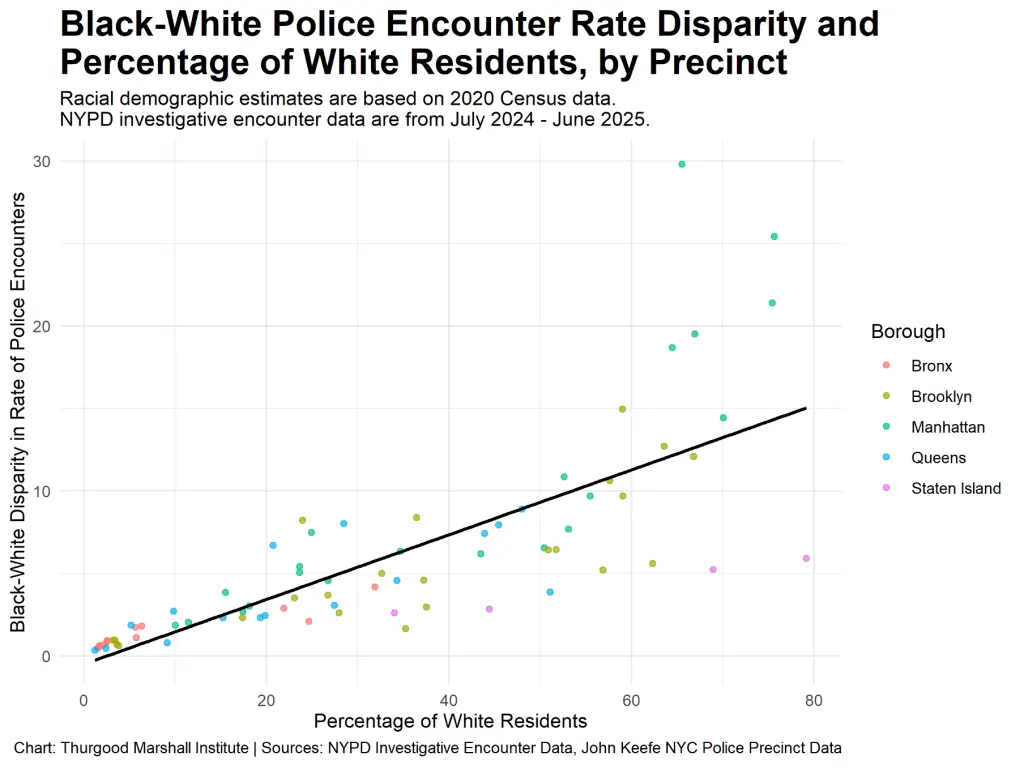
These two findings from the geographic analysis demonstrate the complex relationship between neighborhood racial composition and policing. First, predominantly Black precincts have disproportionately higher police encounter rates overall, suggesting heightened police presence in these neighborhoods. This finding is consistent with research literature documenting that majority-Black neighborhoods around the country—which have historically been deprived of social and economic resources—have a disproportionately high presence of police and an increased likelihood of police interactions.42Cindy B. Dollar, Racial Threat Theory: Assessing the Evidence, Requesting Redesign, 2014 J. Criminology (2014), http://dx.doi.org/10.1155/2014/983026; Eric A. Stewart et al., Neighborhood Racial Context and Perceptions of Police-Based Racial Discrimination Among Black Youth, 47 J. Criminology 847 (2009), https://doi.org/10.1111/j.1745-9125.2009.00159.x.
At the same time, the analysis demonstrates that predominantly white NYC neighborhoods show more evidence of racial disparities in police encounters. This finding that Black-white disparities are significantly larger in precincts with higher shares of white residents aligns with existing research documenting that Black people living in predominantly white neighborhoods are often at particularly heightened risk of police surveillance.43Sandhya Kajeepeta et al., The Relationship Between Intimate Partner Violence Policing and Family Surveillance in Large U.S. Counties, 16 Race & Soc. Probs. 378 (2024), https://doi.org/10.1007/s12552-024-09422-0; Rebecca Fielding-Miller, Peter Davidson, & Anita Raj, Blacks face higher risk of drug arrests in White neighborhoods, 32 Int’l J. Drug Pol’y 100 (2016), https://doi.org/10.1016/j.drugpo.2016.03.008; Stewart et al., supra note 42; Kendralin J. Freeman & Christina R. Steidl, Distribution, Composition and Exclusion: How School Segregation Impacts Racist Disciplinary Patterns, 8 Race & Soc. Probs 171 (2016), https://doi.org/10.1007/s12552-016-9174-9. For example, studies have shown that Black people may experience heightened racial bias from police in predominantly white neighborhoods and that Black students may experience disproportionately high rates of school discipline in more racially integrated schools.44See sources cited supra note 43; Cara McClellan, Challenging Legacy Discrimination: The Persistence of School Pushout as Racial Subordination, 105 Boston U. L. Rev. 641 (2025), https://scholarship.law.upenn.edu/cgi/viewcontent.cgi?article=1561&context=faculty_articles.
While these two findings may initially appear contradictory, they reflect the complex ways in which police interact with Black communities. Racial disparities in policing can manifest in both heightened police presence in majority-Black neighborhoods as well as the profiling of Black people in majority-white neighborhoods, where they are hyper-visible.45Dollar, supra note 42; Kajeepeta et al., supra note 43. The large racial disparities in police encounter rates in predominantly white neighborhoods may be evidence of Black people being seen as inherently suspicious or criminal simply for existing in neighborhoods where they are assumed to “not belong.”
It is important to note that the data publicly released by the NYPD under the How Many Stops Act, while unprecedented, are still limited. The validity of the data depends on complete and accurate reporting by NYPD officers, including relying on officers to report all encounters and to accurately report demographic data and the level of each encounter. There is evidence of rampant underreporting of police stops, which likely impacts the accuracy of these data.46Mylan Denerstein, Twenty-Second Report of the Independent Monitor, Indep. Monitor of the N.Y. Police Dep’t (Oct. 7, 2024), https://www.nypdmonitor.org/wp-content/uploads/2024/10/2024.10.07-937-1-NYPD-Underreporting-of-Terry-Stops-Report.pdf. For example, the court-appointed team overseeing the implementation of reforms to remedy the NYPD’s unlawful stop-and-frisk practices found in October 2024 that officers documented only fifty-nine percent of Level 3 stops with reports in 2023.47Id. Likewise, the How Many Stops Act data may underestimate the true number of investigative encounters in the city.
Furthermore, there are likely encounters for which the officers’ conduct does not align with the requisite level of suspicion. For example, a Level 1 encounter may function as a Level 2 encounter if the police officer asks accusatory questions, but the officer may nonetheless code it as a Level 1 encounter if they lack the “founded suspicion” of criminal activity required in all Level 2 encounters. There is prior evidence of NYPD officers inaccurately reporting encounter types: for a June 2025 report, the court-appointed independent monitor reviewed body-worn camera footage and found that officers often mislabeled Level 3 stops as Level 2 encounters.48Mylan Denerstein, Twenty-Fifth Report of the Independent Monitor, Indep. Monitor of the N.Y. Police Dep’t (June 3, 2025), https://www.nypdmonitor.org/wp-content/uploads/2025/06/963-Twenty-Fifth-Report-of-the-Independent-Monitor.pdf.
Unlike the data the NYPD releases on Level 3 stops, the data on Level 1 and Level 2 encounters include no geographic information aside from precinct. This precludes researchers from conducting any geographic analyses, beyond precinct-level analyses, to assess which neighborhoods or public housing developments experience more police encounters. Lastly, the data do not allow researchers to conduct any crosstab analyses between race and other variables. For example, researchers cannot examine race and the reason for the stop or race and gender.
By definition, Level 1 and Level 2 investigative police encounters are non-invasive interactions in which police officers simply ask for information and a person is free to leave.50Hr’g Test. of Michael Clarke, Dir. of Legis. Affs., N.Y.C. Police Dep’t, before the N.Y. City Council Comm. on Pub. Safety (Mar. 27, 2023)https://legistar.council.nyc.gov/View.ashx?M=F&ID=11815138&GUID=C68501BE-94FB-4300-8452-E111E07B3CCE. However, as the above excerpts from public testimony make clear, any police encounter can feel invasive and traumatic in practice. Further, for people whom officers encounter, the lines between Level 1, 2, and 3 encounters can easily blur because of the intimidating nature of being approached by the police. This section explains why it matters that Black people are disproportionately subjected to police encounters, highlighting the potential consequences for the health, safety, and well-being of individuals, communities, and society at large. Because the NYC How Many Stops Act data on Level 1 and Level 2 encounters are new, the consequences of these police encounters have not yet been studied. Therefore, this section draws on existing research on the impacts of police stops in New York City and police encounters in other jurisdictions to shed light on the potential consequences of low-level police encounters in New York City.
Although Level 1 and Level 2 encounters are strictly investigative, and only Level 3 stops require reasonable suspicion that a person has committed a crime, all investigative encounters represent a form of police surveillance and come with the risk of further contact with the criminal legal system. The disproportionately high rates of investigative encounters in neighborhoods with more Black residents, evidenced through the How Many Stops Act data, suggest that the police more heavily scrutinize these neighborhoods. As a result, Black New Yorkers may face increased contact with police and therefore a disproportionate risk of being ensnared in the criminal legal system.
As expressed in the above public testimony, police investigative encounters can escalate to involve the threat or use of violent force by police. According to the NYPD’s data, 1.6% of all investigative encounters (Levels 1, 2, and 3) resulted in police use of force. That means nearly 43,000 police encounters involve documented use of force by NYPD officers every year, including in some Level 1 and Level 2 encounters for which force is not legally justified. Each time a person is approached by police, there is a risk that they will not make it home without injuries or will not make it home at all.
Another potential consequence of investigative encounters is the psychological trauma that comes with being racially profiled and subjected to police contact on a regular basis. Many Black New Yorkers have described police encounters as part of everyday life.51City Council Comm. on Pub. Safety, supra note 1. Before the How Many Stops Act, no data were available on these low-level police encounters, making it difficult to measure the psychological toll of interacting with police so often. Level 2 and Level 3 encounters come with the added stress of being treated with suspicion and being asked accusatory questions. One study of Black adults presenting to a level 1 trauma hospital found that more frequent discrimination by police was associated with worse emotional and physical well-being and more severe symptoms of post-traumatic stress disorder (PTSD).52Timothy J. Geier et al., History of Racial Discrimination by Police Contributes to Worse Physical and Emotional Quality of Life in Black Americans After Traumatic Injury, 11 J. Racial & Ethnic Health Disparities 1774 (2024), https://doi.org/10.1007/s40615-023-01649-8. Researchers measured this discrimination through a survey that asked participants about their treatment by police officers, including whether police had ever verbally abused them or accused them of having drugs.53Id.; D. English et al., Police and Law Enforcement Scale, APA PsycNet (2017), https://doi.org/10.1037/t61048-000. Another qualitative study of justice-involved Black men found that their chronic exposure to trauma, including trauma from police violence, resulted in poor psychological health outcomes, such as hypervigilance.54Cherrell Green, “I Done Been Through a Lot of Stuff and I Done Seen a Lot of Things”: A Qualitative Analysis of Chronic Stress and Violence Among Justice-Involved Black Men, 51 Crim Just. & Behav. (2024), https://doi.org/10.1177/00938548241227541. Additionally, a study of adolescent Black and Latino boys found that self-reported experiences of police pedestrian stops were associated with greater self-reported psychological distress.55Juan Del Toro et al., The criminogenic and psychological effects of police stops on adolescent black and Latino boys, 116 Proc. Nat’l Acad. Scis. 8621 (2019), https://www.pnas.org/doi/epdf/10.1073/pnas.1808976116.
Using data from the Future of Families and Child Wellbeing Study, an ongoing study of nearly 5,000 children born in major U.S. cities, Kristin Turney, PhD, and Dylan B. Jackson, PhD, found a negative relationship between youth police stopsviiiResearchers measured youth police stops by asking mothers if their child had ever been stopped by police and asking youth if they had ever been stopped by police. Because police stops were measured through self-report, the level of each police encounter was unclear. and their mothers’ health. Specifically, mothers of children who had been stopped by police were more than twice as likely as other mothers to report depression- and anxiety-related sleep difficulties,56Dylan B. Jackson & Kristin Turney, Sleep Problems among Mothers of Youth Stopped by the Police, 98 J. Urb. Health 163 (2021), https://doi.org/10.1007/s11524-021-00518-1. and they also reported worse overall health.57Kristin Turney & Dylan B. Jackson, Mothers’ health following youth police stops, 150 Preventive Med. (2021), https://doi.org/10.1016/j.ypmed.2021.106693. Because Black people experience higher rates of police encounters, as evidenced in the How Many Stops Act data, police encounters may contribute to racialized health disparities for Black mothers.
Since there is more data transparency concerning Level 3 (Terry) stops around the country, researchers have been able to study the consequences of living in a neighborhood with a high rate of Level 3 stops. The new data on Level 1 and Level 2 encounters in New York City offer a novel opportunity for researchers to also study the neighborhood consequences of these lower-level encounters going forward.
Two studies found that living in a New York City neighborhoodixThe studies used the NYC United Hospital Fund’s neighborhood boundaries to track health outcomes (see a map of the boundaries here: https://www.nyc.gov/assets/doh/downloads/pdf/survey/uhf_map_100604.pdf). with a high rate of Level 3 police stops was associated with worse psychological health, including feelings of nervousness and worthlessness, especially among male residents.58Id.; Abigail A. Sewell & Kevin A. Jefferson, Collateral Damage: The Health Effects of Invasive Police Encounters in New York City, 93 J. Urb. Health 42 (2016), https://doi.org/10.1007/s11524-015-0016-7. Living in such neighborhoods was also associated with poorer physical health among residents, including worse self-reported general health status and increased odds of asthma episodes.59Id. Another New York City-based study found that a higher rate of Level 3 stops of Black people in the city was associated with increased psychiatric emergency department visits among Black city residents.60Das & Bruckner, supra note 20. A study in New Orleans, Louisiana, found that neighborhoods with higher stop-and-frisk encounter rates had significantly higher rates of smoking, physical inactivity, poor physical health, reported violent crime, and domestic violence, even after controlling for measures of neighborhood disadvantage.61Katherine P. Theall et al., Neighborhood Police Encounters, Health, And Violence In A Southern City, 41 Health Aff. 228 (2022), https://www.healthaffairs.org/doi/pdf/10.1377/hlthaff.2021.01428.
Other studies of community-level police contact also show that living in a neighborhood with intensive policing is associated with harmful consequences. One study found that the NYPD’s Operation Impact, which increased the number of police officers deployed to certain neighborhoods with a mission of low-level disorder policing and extensive use of pedestrian stops, lowered the educational performance of Black boys, including worse school attendance and test scores.62Joscha Legewie & Jeffrey A. Fagan, Aggressive Policing and the Educational Performance of Minority Youth, 84 Am. Sociol. Rev. 220 (2018), https://scholarship.law.columbia.edu/cgi/viewcontent.cgi?article=3319&context=faculty_scholarship. Additionally, two studies—one in Minneapolis, Minnesota, and one in New Orleans—documented that census tracts with higher rates of police contact have higher risks of pre-term birth, especially among Black residents.63Rachel R. Hardeman et al., Association of Residence in High–Police Contact Neighborhoods With Preterm Birth Among Black and White Individuals in Minneapolis, 4 JAMA Network Open (2021), https://jamanetwork.com/journals/jamanetworkopen/fullarticle/2786940; Jaquelyn L. Jahn et al., Neighborhood Proactive Policing and Racial Inequities in Preterm Birth in New Orleans, 2018‒2019, 113 Am. J. Pub. Health S21 (2023), https://doi.org/10.2105/AJPH.2022.307079.
The negative consequences of the NYPD’s police encounters and their disproportionate effects on Black communities may also extend to broader society, beyond the person being approached and their family and neighbors.
The disproportionate policing of Black New Yorkers in predominantly white precincts can reinforce and exacerbate racial residential segregation, whereby Black people are treated with hostility when living in or simply passing through traditionally “white spaces.”64Stewart et al., supra note 42.
Lastly, TMI’s findings suggest that considerable resources are dedicated each year to conducting millions of police investigative encounters, primarily of Black New Yorkers. This massive investment in police surveillance comes at the expense of potential investments in evidence-based approaches to public safety and social service infrastructure, including health and housing services.
The Trump administration has made efforts to eliminate race and other demographic data collection by many federal government agencies.65Thurgood Marshall Inst., What Project 2025 Means for Black Communities, NAACP Legal Def. Fund, https://tminstituteldf.org/what-project-2025-means-for-black-communities/ (last visited Dec. 5, 2025). These efforts include preventing the Department of Education from tracking racial disparities in school discipline66Presidential Action, Reinstating Common Sense School Discipline Policies (Apr. 23, 2025), https://www.whitehouse.gov/presidential-actions/2025/04/reinstating-common-sense-school-discipline-policies/; Ctr. for Am. Progress, Project 2025’s Distortion of Civil Rights Law Threatens Americans With Legalized Discrimination (Oct. 31, 2024), https://www.americanprogress.org/article/project-2025s-distortion-of-civil-rights-law-threatens-americans-with-legalized-discrimination/. and ending the Centers for Disease Control and Prevention’s practice of collecting gender identity data.67Paul Dans & Steven Groves, eds., Mandate for Leadership 2025: The Conservative Promise, Heritage Found. (2023), https://static.project2025.org/2025_MandateForLeadership_FULL.pdf; Lindsey Dawson, The Trump Administration Executive Order on Gender Continues to Reverberate, KFF (Oct. 14, 2025), https://www.kff.org/lgbtq/the-trump-administration-executive-order-on-gender-continues-to-reverberate/; Ctr. for Am. Progress, supra note 66. Yet, demographic data collection is critical so that advocates, policymakers, and concerned community members can understand the lived experiences of people across groups and identify inequities where they exist.68Andrew Thurston, Data Gaps for Race and Ethnicity Are Holding Back Antiracism Efforts, New Report Says, The Brink (June 22, 2022), https://www.bu.edu/articles/2022/race-ethnicity-data-gaps-delaying-antiracism-efforts/ Incomplete demographic data make it increasingly difficult to combat discriminatory policies and practices.69Id. TMI’s analysis of the first full year of NYPD data released pursuant to the How Many Stops Act demonstrates the importance of data transparency for enhancing the public’s understanding of Black communities’ disproportionate exposure to police.
Data transparency can help shed light on police-civilian interactions and dispel inaccurate perceptions of crime that are fueled by false and pernicious stereotypes. For decades, media coverage of “crime” has often distorted reality and been inconsistent with data.70 Kesha S. Moore, The Truth Behind Crime Statistics 4, Thurgood Marshall Inst. (2022),https://www.naacpldf.org/the-truth-behind-crime-statistics/. Media coverage surrounding public safety tends to focus on sensationalized stories about violence.71Banuka De Silva, The Relationship between Media Consumption and Fear of Crime: A Comprehensive Review, 11 Jurnal Ilmu Budaya 56 (Apr. 23, 2023), https://papers.ssrn.com/sol3/papers.cfm?abstract_id=4430574. Such coverage increases the general public’s feelings of insecurity and can lead individuals to alter their behavior and avoid specific locations.72Michael Tonry, ed., Crime and justice: A review of research 205–261 (U. Chi. Press); Ray Surette, Media, crime, and criminal justice: Images, realities, and policies (5th ed., Thomson/Wadsworth 2007). This is despite the fact that distorted media coverage of crime and the public’s resultant feelings of insecurity are often inconsistent with available crime data. Studies show that the public often perceives crime rates to be greater than the actual rates derived from official police statistics of recorded crimes and crime victimization surveys.73Matthew Manning et al., What Matters More, Perceived or Real Crime?, 163 Soc. Indicators Rsch. 1221 (2022), https://doi.org/10.1007/s11205-022-02924-7. Sensationalized media coverage can increase support for harsher criminal legal policies—posing a direct threat to Black people, who are disproportionately ensnared in a punitive legal system.74Banuka De Silva, supra note 71; Press Release, Equal Just. Initiative, Report Documents Racial Bias in Coverage of Crime by Media (Dec. 16, 2021), https://eji.org/news/report-documents-racial-bias-in-coverage-of-crime-by-media/; Moore, supra note 70, at 5.
To combat these false narratives, the public must have access to accurate data. New York City’s investigative encounter data offer an important, rich source of information by documenting frequent, low-level interactions between civilians and police, depicting common NYPD officer activity. If the public were instead forced to rely only on crime and arrest rates to understand NYPD officer activity, a significant aspect of people’s experiences with NYPD officers would remain concealed.
First, the data reveal that the vast majority of NYPD policing—ninety-eight percent of all investigative encounters—occurs at the lowest encounter level (Level 1). While some may believe that police contact occurs only when an individual commits a crime, TMI’s analysis shows that NYPD officers frequently approach people based on nothing more than a “mere hunch or whim.” Only one percent of investigative encounters were based on a reasonable suspicion that the person had committed, was committing, or was about to commit a crime. Other jurisdictions may follow a similar pattern of low-level police encounters, but it is impossible to confirm without comprehensive data on police-civilian interactions.
Second, the How Many Stops Act data reveal that Black communities face widespread police presence and questioning. Without the newly released data, researchers would understand racial disparities in police contact for only one percent of investigative encounters (that is, Level 3 stops).
When police departments share data on only crime incident reports and arrests, it can further skew the public’s understanding of how police spend their time and spend public resources. Data transparency about the full spectrum of officer activity, including the demographics of people approached by police, can provide insight into the actual allocation of taxpayer-funded law enforcement resources. As public servants, police officers have an obligation to fully and accurately document their encounters with civilians, and as public agencies, police departments have an obligation to share data about officers’ activities with the public.
TMI’s analysis reveals that NYPD officers engaged in ninety-six times as many Level 1 encounters, which do not require any suspicion of criminal activity, as they did Level 3 stops. Data from other jurisdictions similarly demonstrate that a significant amount of police officers’ time is spent on non-criminal matters and officer-initiated stops that are not based on a reasonable suspicion of criminal activity.75Jeff Asher & Ben Horwitz, How Do the Police Actually Spend Their Time?, N.Y. Times (June 19, 2020), https://www.nytimes.com/2020/06/19/upshot/unrest-police-time-violent-crime.html; Catalyst CA, Reimagining Community Safety In California (2022), https://catalyst-ca.cdn.prismic.io/catalyst-ca/126c30a8-852c-416a-b8a7-55a90c77a04e_APCA+ACLU+REIMAGINING+COMMUNITY+SAFETY+2022_5.pdf; Hassan Kanu, Police are not primarily crime fighters, according to the data, Reuters (Nov. 2, 2022), https://www.reuters.com/legal/government/police-are-not-primarily-crime-fighters-according-data-2022-11-02/. For example, eighty-nine percent of the total time spent on stops by the Los Angeles County Sheriff’s Department in 2019 was spent on officer-initiated stops, and less than twelve percent of that time was for officer-initiated stops based on a reasonable suspicion of a crime.76See sources cited supra note 75. Data transparency can therefore shed light on how police departments allocate their resources, which are ultimately a public good.
The How Many Stops Act is a powerful example of persistent local advocacy producing increased transparency in how public resources are used to police communities. TMI’s analysis of the first year of data following the passage of the How Many Stops Act found massive racial disparities in all levels of investigative encounters and confirmed that Level 3 stops are just the tip of the iceberg. These millions of police encounters have serious, racialized consequences for the health and well-being of all New Yorkers, especially Black New Yorkers. TMI’s findings reflect the value of racial demographic data in uncovering racial bias and potential discrimination.
However, the struggle for accurate data collection, transparency, and accountability is ongoing. Given the persistent underreporting of Level 3 stops,77Denerstein, supra note 41. further advocacy is needed to ensure accurate reporting of Level 3 stops as well as Level 1 and Level 2 encounters.
All levels of government—local, state, and federal—should collect and publicly disseminate racial demographic data where feasible to promote government transparency and allow for the monitoring of racial inequities.
Localities should enhance independent oversight by empowering a local department of investigation or oversight commission to conduct checks on data to ensure consistent, complete, and accurate reporting by police and other government agencies, and to determine whether police-civilian interactions are legally justified and nondiscriminatory.
Community members and policymakers should use racial demographic data, where publicly available, to advocate for change. For example, in New York City, advocates can use analyses documenting racial disparities in police encounters to combat discriminatory policing.
Ultimately, data transparency is a right, and the public must defend it. Understanding the full picture of police-civilian interactions, and the scale of disproportionate policing of Black communities, is a first step in advancing a system of community safety that respects the humanity and dignity of all people.