TMI Research and Operations Associate
Six decades ago, in 1965, the Voting Rights Act (VRA)2Voting Rights Act of 1965, Pub. L. No. 89-110, 79 Stat. 437 (codified as amended at 52 U.S.C. § 10101 et seq.), https://catalog.archives.gov/id/299909. was signed into law. The VRA’s goal was to eliminate racial discrimination in voting policies and “to enforce the Fifteenth Amendment to the Constitution of the United States,”3Id. which prohibits denying the right to vote based on a person’s race or skin color.4Fifteenth Amendment, 15 Stat. 346 (1869), https://catalog.archives.gov/id/299797. The VRA outlawed discriminatory, Jim Crow-era barriers such as literacy tests, poll taxes, and voter harassment or intimidation.5Voting Rights Act of 1965, supra note 2. In doing so, the enactment of the VRA was a testament to the United States’ commitment to removing the obstacles that Black people and other marginalized groups continued to experience when exercising their right to vote.
Congress specifically designed Section 2 of the VRA to acknowledge discrimination, including structural racism, and to provide a safeguard against voting laws that harmed Black voters and other marginalized voters.6Brief of Amicus Curiae NAACP Legal Defense & Educational Fund, Inc. in Support of Respondents,Brnovich v. Democratic National Committee, 594 U.S. 647 (Jan. 20, 2021), https://www.supremecourt.gov/DocketPDF/19/19-1257/166773/20210120105614902_Brnovich%20amicus%20FILING.pdf. On paper, Section 2 prohibits states from using any “standard, practice, or procedure” that “results in a denial or abridgement of the right of any citizen of the United States to vote on account of race or color.”7Voting Rights Act of 1965, supra note 2, at Section 2. Until recently, Section 2 of the VRA was a fundamental law that could protect voters from discriminatory voting systems.8NAACP Legal Def. Fund, Supreme Court Strikes Down Louisiana Map and Destroys Key Voting Rights Act Provision (Apr. 29, 2026), https://www.naacpldf.org/press-release/supreme-court-strikes-down-louisiana-map-and-destroys-key-voting-rights-act-provision/. However, as Associate Justice of the U.S. Supreme Court Elena Kagan described in her 2026 dissent in Louisiana v. Callais, Section 2 is now “all but a dead letter.”9Louisiana v. Callais, 608 U.S. ______ (2026), No. 24-109, slip op. (U.S. Apr. 29, 2026), Kagan, J. dissenting at 3, https://www.supremecourt.gov/opinions/25pdf/24-109_21o3.pdf. Before Callais, the Court’s 2021 decision in Brnovich v. Democratic National Committee had already curtailed Section 2 by holding that Arizona’s racially discriminatory laws did not violate the VRA.10Opinion of the Court, Brnovich v. Democratic National Committee,594 U.S. 647 (Jul. 1, 2021), https://www.supremecourt.gov/opinions/20pdf/19-1257_g204.pdf. As a result, the Court created new burdens to challenges of discriminatory voting laws, significantly limiting Section 2’s scope.11NAACP Legal Def. Fund, Case: Brnovich v. Democratic National Committee (Jan. 21, 2021), https://www.naacpldf.org/case-issue/brnovich-v-dnc/. Brnovich was a death knell for the VRA’s protections that would have applied to voter challenges, which have lately become an increasing problem.
In recent years, self-proclaimed “election integrity” organizations and individuals who purport to be concerned about voter fraud have used mass voter challenges to disrupt elections. Mass voter challenges involve disputing a large number of voters’ eligibility, targeting hundreds or thousands of individuals in one filing. The rise of mass voter challenges underscores the importance of defending the right of all eligible voters to freely cast ballots.
For example, in December 2020, the organization True the Vote filed a mass voter challenge in Georgia targeting approximately 364,000 people—nearly five percent of Georgia’s active voters. The challenge was filed just days before the state’s January 5, 2021, runoff election for both of its U.S. Senate seats.12Fair Fight, Inc. v. Engelbrecht, No. 2:20-cv-00302-SCJ, Doc. No. 1 (N.D. Ga. Dec. 23, 2020) at 2,https://clearinghouse.net/doc/142033/. Notably, True the Vote’s mass challenge came shortly after the nation saw historic turnout rates in the November 3, 2020, presidential election,13University of Florida Election Lab, National Turnout Rates Graph, https://election.lab.ufl.edu/national-turnout-rates-graph/. including new turnout records for Black voters.14Jacob Fabina, Despite Pandemic Challenges, 2020 Election Had Largest Increase in Voting Between Presidential Elections on Record, United States Census Bureau (Apr. 29, 2021), https://www.census.gov/library/stories/2021/04/record-high-turnout-in-2020-general-election.html. Voting rights advocates were concerned about True the Vote’s challenge due to its proximity to the runoff election and the scant evidence provided.
In response, Fair Fight, Inc., a Georgia-based nonprofit founded by Stacey Abrams that fights for free and fair elections, filed a lawsuit. In Fair Fight, Inc. v. True the Vote, Fair Fight asked the U.S. District Court for the Northern District of Georgia to put an end to True the Vote’s mass voter challenge as they believed it was a voter suppression tactic.15Fair Fight, Inc. v. Engelbrecht, supra note 12. First, Fair Fight disputed the evidence on which True the Vote based their challenge. Using information from the U.S. Postal Service’s National Change of Address registry, True the Vote claimed that if voters changed their mailing address, this meant that they no longer lived in Georgia and were therefore ineligible to vote in the state. However, Fair Fight contended that this information alone was insufficient to prove that a person was ineligible to vote. Second, Fair Fight argued that True the Vote’s effort to remove approximately 364,000 names from the voter rolls so close to a federal election violated federal law, such as the National Voter Registration Act of 1993 (NVRA), which requires any systematic removal of voters from the voter rolls to occur at least ninety-one days before a federal election.16National Voter Registration Act of 1993, Pub. L. No. 103-31, 107 Stat. 77 (May 20, 1993), https://www.congress.gov/bill/103rd-congress/house-bill/2/text. The U.S. District Court for the Northern District of Georgia found that True the Vote’s mass challenge did not violate Section 11(b) of VRA, which outlaws voter intimidation tactics.17Fair Fight, Inc. v. Engelbrecht,No. 2:20-cv-00302-SCJ, Doc. No. 335 (N.D. Ga. Jan. 2, 2024) at 137, https://www.democracydocket.com/wp-content/uploads/2020/12/2024-01-02-Opinion-And-Memorandum-dckt-335_0.pdf. Although the District Court did not halt True the Vote’s challenge, its opinion did reiterate that mass voter challenges can violate Section 11(b) of the VRA.18Id.
True the Vote’s effort in Georgia is just one of many recent examples of a mass voter challenge. In response to historic voter turnout during the 2020 presidential election cycle, mass voter challenges became a key voter intimidation and suppression strategy to remove eligible voters from the rolls. Furthermore, original research conducted by the Legal Defense Fund (LDF) suggests that these challenges may have disproportionately impacted Black voters in Georgia.
This Brief argues that mass voter challenges unnecessarily burden the voters who are challenged as well as election workers, while having a chilling effect on other voters. All Americans should therefore be concerned by these threats to democracy. The first section of this Brief situates mass voter challenges from 2020 to 2024 within a larger history of voter suppression tactics in the United States. The second section describes the contemporary harms of mass voter challenges. Next, the Brief presents case studies from Georgia and Florida from 2020 through 2024 to illuminate how organizations and individuals use anti-democracy laws and mass voter challenges as voter suppression tactics. The Brief concludes with policy recommendations to curtail the negative impacts that mass voter challenges have on democracy.

Social scientists and legal scholars have long studied how voter suppression tactics in U.S. elections pose great risks to American democracy—and mass voter challenges are one of the latest voter suppression trends.19See, e.g., Carol Anderson, One Person, No Vote (1st Ed. 2019), https://www.bloomsbury.com/us/one-person-no-vote-9781635571394/; Luis Ricardo Fraga, et al., American Democracy and Voter Suppression, ANNALS, 708 AAPSS 227 (Jul. 2023), https://rooneycenter.nd.edu/assets/569543/american_democracy_and_voter_suppression.pdf; Anthony J. Gaughan, American Democracy is Healthier Than it Appears, 100 B.U. L. Rev. 249 (2020), https://heinonline.org/HOL/Page?handle=hein.journals/bulron100&id=225&collection=journals&index=; Daniel E. Smith, Voter Suppression Policies in the 2016 Campaign Cycle, The Roads to Congress 2016: American Elections in a Divided Landscape,Sean D. Foreman and Marcia L. Godwin (Eds.), (2017) at 27-42, https://link.springer.com/chapter/10.1007/978-3-319-58094-4_3. Taken together, various forms of voter suppression throughout U.S. history reveal that the nation has never fully lived up to the promise of a functioning, multi-racial democracy.
Voter suppression tactics disproportionately target voters of color,20The Brennan Ctr. for Justice, Fact Sheet: The Impact of Voter Suppression on Communities of Color (updated Mar. 26, 2026), https://www.brennancenter.org/our-work/research-reports/impact-voter-suppression-communities-color. and research suggests that such suppression contributes to the growing gap in voter turnout by race.21Michael Waldman, Analysis: People of Color Are Being Deterred from Voting, The Brennan Ctr. for Justice (Mar. 6, 2024), https://www.brennancenter.org/our-work/analysis-opinion/people-color-are-being-deterred-voting. In a 2023 article, political scientists Dr. Luis Ricardo Fraga, Dr. Ricardo Ramírez, and Dr. Bernard L. Fraga argue that voter suppression has been and continues to be one of the greatest weaknesses of American democracy.22Fraga, et al., supra note 19. They further argue that the recent rise in voter suppression tactics has its origins in concerns about major national demographic shifts.23Id. In short, a healthy democracy ensures that members of all racial groups can exercise their right to vote. However, the United States has never upheld true democratic principles because it has historically relied on voter suppression to exclude certain groups—particularly Black people—from the political process. Similarly, legal scholar Renalia DuBose argues that voter suppression is an American legacy.24Renalia DuBose, Voter Suppression: A Recent Phenomenon or an American Legacy?, 50 U. Balt. L. Rev. 245 (2021), https://heinonline.org/HOL/Page?collection=journals&handle=hein.journals/ublr50&id=262&men_tab.
A truthful and comprehensive history of voting rights in the United States must acknowledge both the slow but progressive expansion of voter eligibility as well as the ongoing fight to ensure that eligible voters do not experience suppression. Significant changes occurred with the ratification of the Reconstruction Amendments between 1865 and 1870iAlso known as the “Civil War Amendments,” the Reconstruction Amendments are the Thirteenth, Fourteenth, and Fifteenth Amendments to the U.S. Constitution. These three amendments were passed following the end of the U.S. Civil War in an effort to establish equal rights for Black people. The Fourteenth and Fifteenth Amendments are most relevant to this Brief, as the former provided citizenship to Black people born in the United States and the latter extended voting rights to Black male citizens.: the Fourteenth Amendment established that Black people born in the United States were citizens and that all persons are entitled to equal protection under the law,25U.S. Const. amend XIV, https://constitution.congress.gov/constitution/amendment-14/. and the Fifteenth Amendment extended the right to vote to citizens regardless of “race, color, or previous condition of servitude.”26U.S. Const. amend XV, https://constitution.congress.gov/constitution/amendment-15/.
While the Fifteenth Amendment paved the way for all male citizens regardless of race to vote, voter suppression tactics made it difficult for eligible Black male voters to exercise this right. Around the same time that the Reconstruction Amendments were ratified, Jim Crow laws were introduced across the South and reinforced a racial caste system.27Dr. David Pilgrim, What Was Jim Crow, Jim Crow Museum (edited 2012), https://jimcrowmuseum.ferris.edu/what.htm. Under that system, political officials altered state constitutions to effectively deny many Black men their right to vote.28Quinn Yeargain, The Racist History of State Constitutions Taking Voting Rights from People Convicted of Crimes, State Court Report (updated May 8, 2023), https://statecourtreport.org/our-work/analysis-opinion/racist-history-state-constitutions-taking-voting-rights-people-convicted. These state constitutions contained provisions about poll taxes, literacy tests, grandfather clauses, and other forms of intimidation and suppression that prohibited Black men from exercising their newly acquired right to vote.29National Archives, African American Heritage: Black Americans and the Vote, https://www.archives.gov/research/african-americans/vote.
All-white primaries: Primary elections are held to determine which candidates will appear on the ballot in a general election. Although primaries are common across the country today, they were not widespread until the 1870s.30J. Morgan Kousser, The Shaping of Southern Politics: Suffrage Restriction and the Establishment of the One-Party South, 1880-1910(Yale University Press, 2nd Ed. 1975) at 73, https://authors.library.caltech.edu/records/6qj9m-mbh33. In the years following Reconstruction, Black people in the U.S. South experienced disenfranchisement, and politicians established all-white primaries that excluded anyone who was not white from participating.31Id. at 72. Such exclusionary primaries would not be struck down until the 1944 U.S. Supreme Court decision in Smith v. Allwright,32Smith v. Allwright, 321 U.S. 649 (1944), https://tile.loc.gov/storage-services/service/ll/usrep/usrep321/usrep321649/usrep321649.pdf. which was argued by LDF founder Thurgood Marshall.33Carrie Hagen, Smith v. Allwright: the LDF Voting Rights Case That “Changed the Whole Complexion of the South,” NAACP Legal Def. Fund. (Sep. 22, 2024), https://ldfrecollection.org/stories/smith-v-allwright/.
Grandfather clauses: Grandfather clauses allowed individuals to be exempt from voting eligibility requirements if their ancestors were eligible to vote. After Reconstruction, many Southern states used grandfather clauses to prevent Black people from voting—even though the Fifteenth Amendment outlawed denying a citizen the right to vote based on their “race, color, or previous condition of servitude.” For example, in the early 1900s, the Oklahoma State Constitution had a literacy requirement attached to voting eligibility, but residents could be exempt from that requirement if their ancestors could vote before January 1, 1866.34National Archives, Records of Rights: The Grandfather Clause in Oklahoma 1910, http://recordsofrights.org/events/78/the-grandfather-clause-in-oklahoma. Since many Black people’s grandfathers were enslaved and therefore could not vote at that time, the grandfather clause was of no benefit to them. Instead, it removed the literacy requirement for white people who were descendants of voters. Grandfather clauses were deemed unconstitutional in the 1915 U.S. Supreme Court decision in Guinn v. United States.35Guinn v. United States, 238 U.S. 347 (1915), https://tile.loc.gov/storage-services/service/ll/usrep/usrep238/usrep238347/usrep238347.pdf.
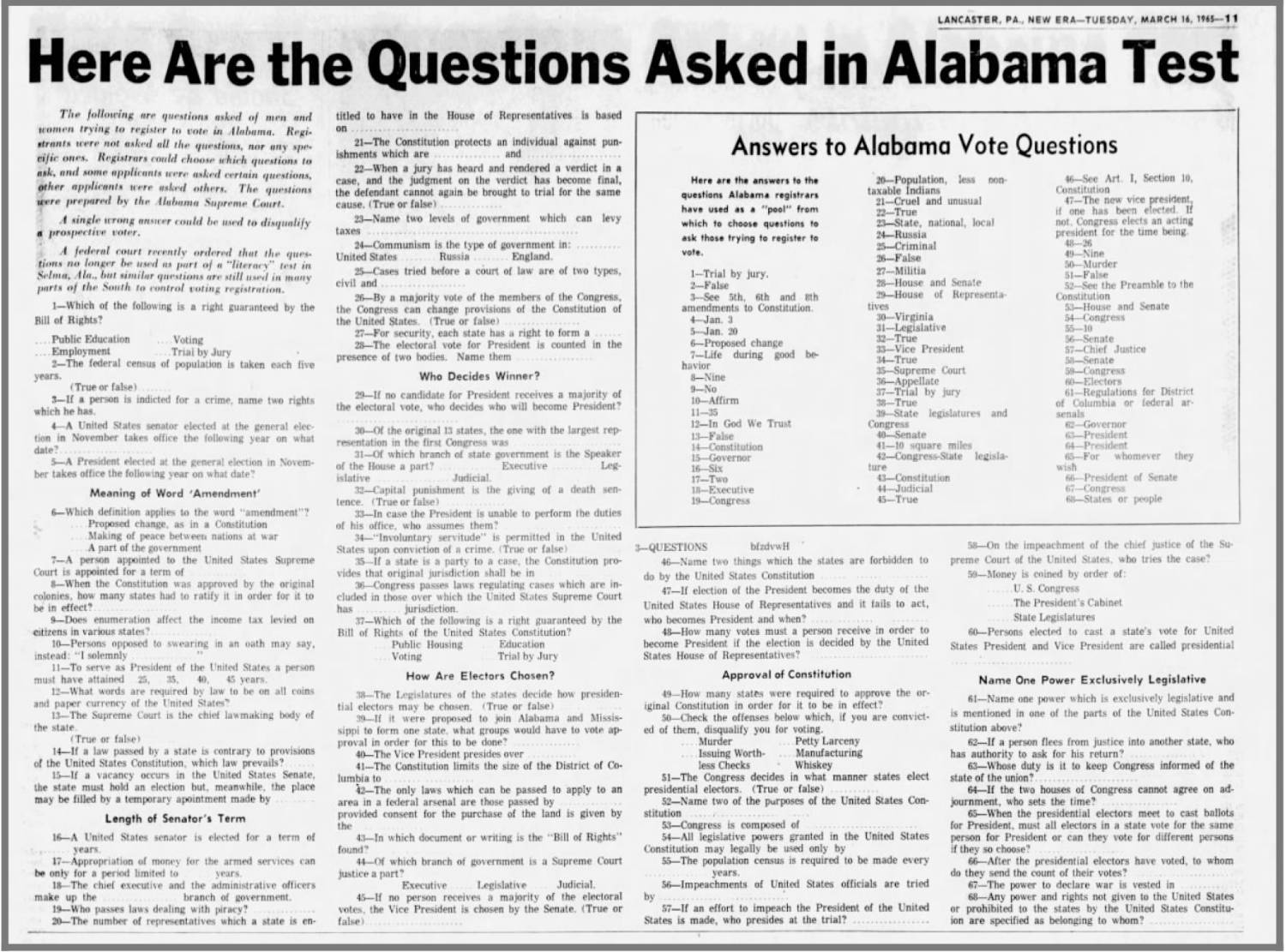
Literacy tests: Literacy tests were exams that some states, mainly those in the South, administered after the ratification of the Reconstruction Amendments. Research shows that these tests prevented large swaths of marginalized voters, including Black people, from voting.36Elizabeth U. Cascio and Ebonya L. Washington, Valuing the Vote: The Redistribution of Voting Rights and State Funds Following the Voting Rights Act of 1965,Nat’l. Bureau of Economic Research, NBER Working Paper No. 17776 (rev. Aug. 2012) at 7-8, https://www.nber.org/system/files/working_papers/w17776/w17776.pdf. Literacy tests were a prerequisite to voting and supposedly assessed whether someone could read and write in English. However, the tests were often long and complicated, and policymakers designed the tests to be unfair even to a literate person. For example, one edition of Alabama’s literacy test asked, “Does enumeration affect the income tax levied on citizens in various states?” as one of the sixty-eight questions a prospective voter had to answer.37Here Are the Questions Asked in Alabama Test, Lancaster, Pa. New Era (Mar. 16, 1965), https://jimcrowmuseum.ferris.edu/question/2023/images/Lancaster_New_Era_1965.jpg. The VRA ended the use of literacy tests in 1965.3852 U.S.C. § 10303, https://uscode.house.gov/view.xhtml?req=granuleid:USC-prelim-title52-section10303&num=0&edition=prelim.
Poll taxes: After Reconstruction, many Southern states required eligible voters to pay a fee, also known as a poll tax, before voting. Although the Fifteenth Amendment expanded voting eligibility to Black men, policymakers implemented poll taxes as a voter suppression tool to make it harder for poor and Black people to vote.39Valencia Richardson, Voting While Poor: Reviving the 24th Amendment and Eliminating the Modern-Day Poll Tax, Vol. XXVII No. 3 The G’town Journal on Poverty Law and Policy 451 at 455 (2020), https://www.law.georgetown.edu/poverty-journal/wp-content/uploads/sites/25/2020/06/05-Richardson_Final_Proof.pdf From 1889 to 1910, eleven Southern states had poll taxes.40EBSCO Information Services, Poll tax, https://www.ebsco.com/research-starters/history/poll-taxes-united-statespoll-tax; Andrew Kirshenbaum, The Injustice of the Poll Tax and Why It Took a Constitutional Amendment to Stop It, The Center for Voting and Democracy (May 1, 2003), https://archive3.fairvote.org/articles/the-injustice-of-the-poll-tax-and-why-it-took-a-constitutional-amendment-to-stop-it/. For example, Alabama’s poll tax was $1.50, which amounted to one week’s pay for some low-wage workers.41Richardson, supra note 39, at 454. This made it difficult for low-wage workers, especially formerly enslaved people, to pay the tax and vote. Poll taxes were thus extremely cost-prohibitive and racially discriminatory. The ratification of the Twenty-Fourth Amendment in 1964 prohibited poll taxes in federal elections.42U.S. Const. amend XXIV, https://constitution.congress.gov/constitution/amendment-24/. Poll taxes were not outlawed in state and local elections until the 1966 U.S. Supreme Court decision in Harper v. Virginia Board of Elections.43Harper v. Virginia Bd. of Elections, 383 U.S. 663 (1966), https://tile.loc.gov/storage-services/service/ll/usrep/usrep383/usrep383663/usrep383663.pdf.
Historically, policymakers implemented voter suppression tactics in response to enfranchising efforts that gave voters of color, and specifically Black voters, greater access to the ballot box. As explained later in this Brief, mass voter challenges today are similarly a response to growing turnout among voters of color.
Although mass voter challenges have become more common in recent years, voter challenge laws have a long history in the United States and can be traced back to as early as the Revolutionary War.44Waldman, supra note 21, at 7. One voter challenge law from 1781 allowed New York residents to file challenges against those suspected of being loyal to Great Britain.45Laws of the State of New York: Passed at the Sessions of the Legislature Held in the Years 1777-1784, inclusive (Weed, Parsons, 1886) at 355-6, https://books.google.com/books?id=0N8TAAAAYAAJ&pg=PA558&dq=Weed+Parsons+New+Yo&source=gbs_toc_r&cad=2#v=onepage&q=Weed%20Parsons%20New%20Yo&f=false; Nicolas Riley, Voter Challenges,The Brennan Ctr. for Justice (2012) at 7, https://www.brennancenter.org/sites/default/files/legacy/publications/Voter_Challengers.pdf. Several states also enacted voter challenge laws at the beginning of Reconstruction.46Riley, supra note 45, at 7. In recent years, there has been a resurgence of voter challenges under these longstanding laws. For example, Georgia’s voter challenge statutes have existed since at least 1933,47Ga. Code of 1933, § 34-605, https://digitalcommons.law.uga.edu/ga_code/32/. but they were largely unutilized before 2020.48Secure Families Initiative v. Raffensperger, No. 1:24-cv-04659-SDG, Doc. No. 1 (N.D. Ga. Oct. 15, 2024) at 23, https://campaignlegal.org/sites/default/files/2024-10/SFI%20v.%20Raffensperger%20Complaint.pdf. Lately, individuals and organizations have used voter challenge laws to discriminate against voters of color and have gone beyond the scope of curtailing voter fraud, which is an exceedingly rare phenomenon.49The Brennan Ctr. for Justice, Resource: Debunking the Voter Fraud Myth (Jan. 31, 2017), https://www.brennancenter.org/our-work/research-reports/debunking-voter-fraud-myth.
As with other voter suppression tactics, people have often used voter challenge laws of the past and present to target voters of color even though the laws are facially race neutral (meaning that the laws do not contain any language directly stating that voters of color are ineligible to vote). A 2012 report from the Brennan Center for Justice found that following the U.S. Civil War, some states put forth or amended voter challenge laws with the intent to hinder the political participation of newly enfranchised voters of color, most of whom were Black men.50Riley, supra note 45, at 2. For example, Florida’s challenge statute was part of the state’s election laws as early as 1845.51Id. at 8; Acts of the Legislative Council of the Territory of Florida, Twenty-Third Session (W. & C. J. Bartlett, 1845) at § 10, https://books.google.com/books?id=mwM4AAAAIAAJ&pg=PA1&source=gbs_toc_r&cad=2#v=onepage&q=on%20voters%20being%20challenged&f=false. At the time, Florida’s election laws defined voters as free white men ages twenty-one years and older who were U.S. citizens, had a home in Florida, and had served in the military or were exempt from serving by law. If someone filed a challenge questioning a person’s eligibility to vote, election inspectors would investigate the claim.52Riley, supra note 45, at 8; Acts Leg. Counc. Terr. Florida, supra note 51, at § 4. After the Fifteenth Amendment granted Black men the right to vote, Florida passed several laws in 1877 to suppress Black voter turnout.53Riley, supra note 45, at 8. One such law required every challenged voter to provide two witnesses from their district who were each known to at least two polling place officials to vouch for their eligibility to vote.54General Acts and Resolutions Adopted by the Legislature of Florida, Ninth Session (Chas. E. Dyke, Sr., 1877) § 7, https://books.google.com/books?id=kAA4AAAAIAAJ&dq=editions%3ADB9xqkFdQ0wC&pg=PA72#v=onepage&q&f=false. The Brennan Center for Justice noted that while the text of this law was race neutral, this requirement placed Black male voters at a disadvantage because Florida was racially segregated, and thus finding witnesses who knew polling place officials was difficult.55Kousser, supra note 30, at 94; Riley, supra note 45, at 8.
In another instance of using voter challenge laws to disenfranchise Black voters, Eugene Talmadge orchestrated challenges against Black voters during his Georgia governor campaign in 1946. After the ruling in Smith v. Allwright outlawed all-white primaries in 1944, groups such as the National Association for the Advancement of Colored People (NAACP) led successful grassroots campaigns to register Black people to vote across the South. In Georgia, the number of Black residents who were registered to vote exploded: there were approximately 20,000 registered Black voters in 1940 and nearly 200,000 in 1946.56Rick Doner, Opinion: Voter challenges have troubling history in Ga.,The Atlanta Journal-Constitution (Sep. 20, 2022), https://www.ajc.com/opinion/opinion-voter-challenges-have-troubling-history-in-ga/FEFYSHRGSRBHXIIXJGKU6DHKYA/. In response to the abolition of Georgia’s all-white primary elections, Talmadge alleged that Black voters were not registered correctly and therefore could not vote in the primaries.57Joseph L. Bernd, White Supremacy and the Disfranchisement of Blacks in Georgia, 1946,66 Ga. Hist. Qtrly. 4, 492 (1982), https://www.jstor.org/stable/40580970. He pointed to race-neutral language in the Code of Georgia, which at the time stated that voters could be challenged if they could not correctly read, write, or interpret any part of the U.S. Constitution or Georgia Constitution. Talmadge’s headquarters mailed challenge forms to his supporters across the state and encouraged them to file voter challenges.58Id. at 494. This opened the door for many targeted challenges against Black voters, and the Federal Bureau of Investigation (FBI) investigated these claims.59Id. at 492-493. The FBI investigators found that Black voters in various Georgia counties were challenged en masse by Talmadge supporters, who often did not specify exactly which, if any, voting qualification the challenged person had allegedly failed to meet.60Id. at 511. Nonetheless, as many as 25,000 Black voters were purged from the rolls across more than thirty counties.61Bernd, supra note57.
Thus, voter challenges have a long history as a tool to suppress Black people’s right to vote. Voter challenge laws, some of which date back to the eighteenth century, have always presented an opportunity for bad-faith actors to question someone’s eligibility to vote and have often had a discriminatory effect. These laws have strayed from the ostensible goal of ensuring that only eligible voters can cast a ballot and instead have been weaponized against voters of color. Today, mass voter challenges continue to create undue burdens for voters who are challenged and have a chilling effect on other Black voters looking to cast their ballot. It is particularly concerning that mass voter challenges have recently surged as backlash to record turnout among Black voters.
The volume of mass voter challenges has risen dramatically in recent years. A report from 2012 highlighted egregious examples of challenges from 2000 to 2012 that targeted voters of color, student voters, low-income voters, and voters with disabilities.62Riley, supra note 45. It has since become common for hundreds or even thousands of voters to be challenged at once. Since 2020, the number of mass voter challenges being filed has reached unprecedented levels.63Nick Corasaniti and Alexandra Berzon, Activists Flood Election Offices With Challenges,The New York Times (Sep. 28, 2022), https://www.nytimes.com/2022/09/28/us/politics/election-activists-voter-challenges.html. In 2022 alone, groups and individuals challenged 92,000 voters across Georgia.64Jane C. Timm, Fraud hunters challenged 92,000 voter registrations in Georgia last year,NBC News (Feb. 27, 2023), https://www.nbcnews.com/politics/elections/fraud-hunters-challenged-92k-georgia-voter-registrations-2022-rcna71668.
Mass voter challenges likely have a chilling effect: hearing that some people have had their voting eligibility challenged could dissuade other people from attempting to vote because of their fear that they too will be challenged. Researchers should further study how learning about mass voter challenges impacts voters who are not directly targeted—specifically, whether reading or hearing about mass voter challenges in a potential voter’s state deters them from voting. Mass voter challenges are a voter suppression tool, and existing research suggests that voter suppression tactics such as voter identification laws can have a chilling effect on other voters.65Jennifer Darrah-Okike, et al., The Suppressive Impacts of Voter Identification Requirements,64 Sociological Perspectives 4, 1 (Aug. 2021), https://journals.sagepub.com/doi/abs/10.1177/0731121420966620.
The voter fraud myth involves spreading misinformation that election results are inaccurate and that voter fraud is rampant. Over the past five years, this myth has fueled an increase in mass voter challenges. Many of President Donald Trump’s supporters have repeated a discredited voter fraud narrative about the 2020 presidential election: the “Big Lie,” claiming that the election was stolen.66Zachary B. Wolf, The 5 key elements of Trump’s Big Lie and how it came to be, CNN Politics (May 19, 2021), https://www.cnn.com/2021/05/19/politics/donald-trump-big-lie-explainer/index.html. The term “Big Lie” originated from Adolf Hitler, who wielded an antisemitic claim that Jewish people in Europe were the reason Germany lost World War I.67Zachary Jonathan Jacobson, Many are worried about the return of the ‘Big Lie.’ They’re worried about the wrong thing., The Washington Post (May 21, 2018), https://www.washingtonpost.com/news/made-by-history/wp/2018/05/21/many-are-worried-about-the-return-of-the-big-lie-theyre-worried-about-the-wrong-thing/ Similarly, the “Big Lie” in the wake of the 2020 U.S. presidential election took a false claim and made it a tool of propaganda, moving a country away from democracy and the truth and toward authoritarianism. Those who believe in the “Big Lie” claim that ineligible voters cast ballots, presumably for Joe Biden, which caused Trump to lose the election.68Wolf, supra note 66. However, these claims have been repeatedly debunked.69See, e.g., PBS News Hour Transcript,(Dec. 17, 2021), https://www.pbs.org/newshour/show/exhaustive-fact-check-finds-little-evidence-of-voter-fraud-but-2020s-big-lie-lives-on. Although Congress certified the Electoral College results and confirmed that Biden won,70167 Cong. Rec. 4, H76-H115 (2021), https://www.congress.gov/congressional-record/volume-167/issue-4/house-section/article/H76-4. some proponents of the “Big Lie” took matters into their own hands and filed voter challenges en masse. Such challenges, which are often filled with inaccuracies and based on insufficient evidence, pose substantial threats to the legitimacy and viability of U.S. democracy.
The recent rise in mass voter challenges is also occurring alongside nationwide efforts to discredit the technology used to maintain voter rolls, including attacks on the Electronic Registration Information Center (ERIC). ERIC is a nonprofit and nonpartisan membership organization that helps states maintain accurate voter registration rolls. ERIC was created shortly after The Pew Charitable Trusts released a 2012 report that concluded that voter registration lists and maintenance processes were outdated.71The Pew Ctr. on the States, Inaccurate, Costly, and Inefficient: Evidence That America’s Voter Registration System Needs an Upgrade (Feb. 14, 2012), https://www.pewtrusts.org/en/research-and-analysis/reports/2012/02/14/inaccurate-costly-and-inefficient-evidence-that-americas-voter-registration-system-needs-an-upgrade (full document available at https://www.pewtrusts.org/-/media/legacy/uploadedfiles/pcs_assets/2012/pewupgradingvoterregistrationpdf.pdf). The report recommended a modernized system for voter registration and maintenance that reflected new advancements in technology, and ERIC was launched the same year.72Electronic Registration Information Center (ERIC), FAQ at #7, https://ericstates.org/faq/; Pew Ctr., supra note 71, at 8-9.
ERIC uses an intricate system that goes beyond the error-prone technology commonly used to curate names for mass voter challenges.73The Pew Charitable Trusts, Evaluation Finds ERIC Improves Election Performance (Jan. 7, 2014),https://www.pew.org/en/research-and-analysis/articles/2014/01/07/evaluation-finds-eric-improves-election-performance. Member states routinely submit both voter registration data and data from motor vehicle departments to ERIC. Then, ERIC staff use data-matching software to compare that information across all member states and other sources, such as official death data from the Social Security Administration,74ERIC, Technology & Security Overview, https://ericstates.org/security/. to produce seven “list maintenance” reports.75ERIC, How ERIC Works,https://ericstates.org/how-does-it-work/. For example, ERIC licenses data from the U.S. Postal Service to identify voters who have changed their address or moved, and this information makes up ERIC’s National Change of Address (NCOA) report.76Id. The NCOA report is just one part of a larger puzzle that states subscribed to ERIC can use to help maintain their voter rolls. The U.S. Election Assistance Commission, an independent agency of the U.S. government, recommends that when election officials receive NCOA data stating that someone has moved, they should send the person a confirmation of address notice.77U.S. Election Assistance Comm., Election Administration and Voting Survey (EAVS) 2022 Comprehensive Report (Jun. 2023) at 139,https://www.eac.gov/sites/default/files/2024-11/2022_EAVS_Report_508c.pdf. Therefore, NCOA data can be a starting point to investigate whether someone is still eligible to vote in a state, but this information should not be the sole deciding factor.
Despite its comprehensiveness, ERIC has faced unwarranted attacks fueled by conspiracy theories. Opponents have attempted to replace ERIC with technology that does not begin to capture the complexity of maintaining voter rolls in a digital age. Many states have recently left ERIC because of unsubstantiated claims of data inaccuracy.78Alice Clapman, States Cave to Conspiracy Theories and Leave Voter Data Cooperative, ERIC,The Brennan Ctr. for Justice (Aug. 10, 2023), https://www.brennancenter.org/our-work/analysis-opinion/states-cave-conspiracy-theories-and-leave-voter-data-cooperative-eric. In 2022 and 2023, Alabama,79Press Release, Alabama Secretary of State, Secretary of State Wes Allen officially withdraws from ERIC Organization (Jan. 16, 2023), https://www.sos.alabama.gov/index.php/newsroom/secretary-state-wes-allen-officially-withdraws-eric-organization. Louisiana,80Press Release, Louisiana Secretary of State, Louisiana to Suspend Participation in Voter Registration Compact (Jan. 27, 2022), https://www.sos.la.gov/OurOffice/PublishedDocuments/FINAL%20VERSION-1.27.22%20ERIC%20PR.pdf. Missouri,81Letter from John R. Ashcroft, Missouri Secretary of State, to Shane Hamlin, Executive Director of ERIC (Mar. 6, 2023), https://www.democracydocket.com/wp-content/uploads/2023/03/03-06-23_Ashcroft_Letter_ERIC.pdf. Florida,82Press Release, Florida Department of State, Florida Withdraws From Electronic Registration Information Center (ERIC) Amid Concerns About Data Privacy and Blatant Partisanship (Mar. 6, 2023), https://dos.myflorida.com/communications/press-releases/2023/press-release-florida-withdraws-from-electronic-registration-information-center-eric-amid-concerns-about-data-privacy-and-blatant-partisanship/. Ohio,83Letter from Frank LaRose, Ohio Secretary of State, to Shane Hamlin, Executive Director, Electronic Registration Information Center (ERIC), re: Notice of Resignation from ERIC (Mar. 17, 2023), https://ohiocapitaljournal.com/wp-content/uploads/2023/09/LaRoseERIC.pdf. Iowa,84Iowa Secretary of State Paul Pate (@IowaSOS), A Statement from Iowa Secretary of State Paul Pate,X (Mar. 17, 2023), https://x.com/IowaSOS/status/1636839092074717187; Katarina Sostaric, Iowa is officially out of a group that helps clean voter rolls, and the path forward isn’t clear, Iowa Public Radio (Jun. 19, 2023), https://www.iowapublicradio.org/state-government-news/2023-06-19/iowa-is-officially-out-of-a-group-that-helps-clean-voter-rolls-and-the-path-forward-isnt-clear. Texas,85Letter from Jane Nelson, Texas Secretary of State, to Shane Hamlin, Executive Director, Electronic Registration Information Center, Inc. (Jul. 20, 2023), https://www.documentcloud.org/documents/23883050-file_8020/. Virginia,86Letter from Susan J. Beals, Virginia Department of Elections Commissioner, to Shane Hamlin, Executive Director, Electronic Registration Information Center (ERIC) (May 11, 2023), https://www.documentcloud.org/documents/23810805 “-file_0097-2/. and West Virginia87Letter from Mac Warner, West Virginia Secretary of State, to Shane Hamlin, Executive Director, Electronic Registration Information Center, Inc. (Mar. 6, 2023), https://www.democracydocket.com/wp-content/uploads/2023/03/ERIC-Resignation-Letter-Final-03.06.2023.pdf. left ERIC. All of these states, except for Texas and West Virginia, alleged that ERIC had data security issues or was partisan.88Alabama Sec. State, supra note 79; Louisiana Sec. State, supra note 80; Ashcroft, supra note 81; LaRose, supra note 83; Pate, supra note 84; Sostaric, supra note 84; Nelson, supra note 85. ERIC’s leadership denied these allegations in early 2023.89ERIC, An Open Letter from ERIC’s Executive Director (Mar. 2, 2023),https://ericstates.org/an-open-letter/.
The “Big Lie” and attacks on ERIC have both fed into the growing trend of mass voter challenges. While this Brief focuses on mass voter challenges in Georgia and Florida from 2020 to 2024, it is important to note that mass voter challenges have also been reported in other states, and the phenomenon is not limited to the South.90Protect Democracy, Unraveling the rise of mass voter challenges (Jun. 17, 2024), https://protectdemocracy.org/work/voter-challenges/. This Brief focuses on Georgia and Florida because of the volume of voter challenges filed and the attempts to disenfranchise large numbers of eligible Black voters in each state.
Further, analyzing mass voter challenges post-2020 zeroes in on how organizations and individuals have used these challenges as a voter suppression tactic following an election cycle where voters of color took to the ballot box in large numbers. The 2020 presidential election saw high voter registration and turnout rates across the nation, including among voters of color.91Fabina, supra note 14. Two-thirds (66.8%) of all U.S. citizens who were at least eighteen years old cast a ballot, and Asian Americans and Hispanic Americans who were at least eighteen years old saw higher turnout rates than in any presidential election since at least 2008 (fifty-nine percent and fifty-four percent, respectively).92Id. Non-Hispanic Black U.S. citizens who were at least eighteen years old had a higher turnout rate than in 2016 (sixty-three percent vs. sixty percent).93Id. The increase in mass voter challenges following the 2020 election is likely a response to these high voter turnout rates.

Two anti-democracy laws recently enacted in Georgia, Senate Bill 18994O.C.G.A. § 21-2-230 (formerly SB 189), https://gov.georgia.gov/document/2025-signed-legislation/hb-697/download. and Senate Bill 202,95Ga. Election Integrity Act of 2021 (formerly SB 202), https://www.legis.ga.gov/api/legislation/document/20212022/201498. underscore the connection between voter suppression and mass voter challenges. Together, these laws make it easier to file voter challenges by allowing challenges against voters with a “nonresidential” address and allowing people to file an unlimited number of challenges. This expansion of voter challenge laws incorrectly focuses on markers that do not actually make someone ineligible to vote. Instead, the laws place a target on the backs of certain voters, including those who are in college or are unhoused, and make them more susceptible to having their voter eligibility challenged.
The passage of S.B. 18996O.C.G.A. § 21-2-230. during the 2023–2024 legislative session amended Chapter 2 of Title 21 of the Official Code of Georgia97O.C.G.A. Title 21, Ch. 2, https://law.justia.com/codes/georgia/2010/title-21/chapter-2/. to address challenges based on a “nonresidential” address. This law ignores that there are a variety of reasons why someone’s address on their voting file would be “nonresidential” (for example, someone living in a college dormitory or a homeless shelter would have a nonresidential address), and it falsely equates this status with ineligibility to vote in Georgia. The harm of this law was evident within months of its enactment: in the fall of 2024, 689 student voters were challenged in Chatham County, Georgia. The students were either currently or formerly enrolled at Savannah State University,98Eli Saslow, 3 Georgia Women, Caught Up in a Flood of Suspicion About Voting, The New York Times (Sep. 15, 2024), https://www.nytimes.com/2024/09/15/us/politics/georgia-voting-2024-election.html. a historically Black university where most of the student body is Black.99Savannah State University, SSU Fast Facts and Figures 2021-2022 at 2, https://web.archive.org/web/20220302090253/https://www.savannahstate.edu/irp/documents/ssu-fast-facts-and-figures-2021-2022.pdf.
In 2023, a ProPublica article detailed the unique burden placed on unhoused people whose voting eligibility is challenged. The article featured two unhoused people in Forsyth County, Georgia, Joseph Riggs and Barbara Helm. Although their experiences are their own, they speak to larger barriers that many unhoused voters face. Both Riggs and Helm had their voting eligibility challenged and were ultimately removed from the voter rolls ahead of the 2022 election because they did not contest their challenges. Riggs found the process to prove his eligibility to be too laborious, expensive, and dangerous. For example, he would need to take unpaid time off from work and find money for transportation. In addition, he did not want to place himself in danger, as there were reports of arrests being made due to suspected voter fraud. Helm did not see the initial letter notifying her of the challenge in the mail, nor did she receive another letter alerting her of her removal from the voter rolls. The reporters found that Forsyth County was the most aggressive of thirty Georgia counties in approving voter challenges, even though voting rights lawyers warned that the challenges may violate the NVRA.100Doug Bock Clark, Close to 100,000 Voter Registrations Were Challenged in Georgia – Almost All by Just Six Right-Wing Activists,ProPublica (Jul. 13, 2023), https://www.propublica.org/article/right-wing-activists-georgia-voter-challenges. The NVRA set specific limits on how and when voters can be removed from the voter rolls, such as if a voter is confirmed to have died or if the voter confirms in writing that they changed residences.10152 U.S.C. § 20507(a)(3); 52 U.S.C. § 20507(d), https://uscode.house.gov/view.xhtml?path=/prelim@title52/subtitle2/chapter205&edition=prelim.
Although it is difficult to ascertain the exact number of unhoused voters, the instability of homelessness likely deters many unhoused people from voting. In a 2012 report, the National Coalition for the Homeless estimated that around ten percent of unhoused people vote in elections each year,102Jin Zhao, Why We Should Care About the Homeless Vote,AlterNet via Nat’l Coal. for the Homeless (Aug. 9, 2012), https://nationalhomeless.org/care-homeless-vote/. far less than the estimated fifty-four percent of the total voting-age population that voted in 2012.103Dora Kingsley Vertenten, As few as 1 in 10 homeless people vote in elections – here’s why,USC Price School of Public Policy (Oct. 14, 2020), https://web.archive.org/web/20250320181213/https://priceonline.usc.edu/blog/as-few-as-1-in-10-homeless-people-vote-in-elections-heres-why/; US Elections Project, 2012 November General Election Turnout Rates (updated Sept. 3, 2014), http://www.electproject.org/2012g. In a 2024 article in The Nation, advocates for unhoused voters said a major barrier is misinformation, including the incorrect belief that being unhoused automatically means a person does not have the right to vote.104Maggie Grether, The Hidden Barriers to Voting While Unhoused,The Nation (Oct. 23, 2024), https://www.thenation.com/article/politics/voting-barriers-suppression-unhoused-homelessness/. Compounding these issues, a provision of S.B. 189 that prohibits unhoused voters from registering to vote anywhere other than their county registrar’s office went into effect in January 2025.105Ga. Gen. Assy., SB 189, Current Version, https://www.legis.ga.gov/legislation/64471; WSBTV.com News Staff, Georgia election law’s provisions on unhoused voters, absentee ballot storage takes effect,WSB-TV2 Atlanta (Jan. 1, 2025), https://www.wsbtv.com/news/local/atlanta/georgia-election-laws-provisions-unhoused-voters-absentee-ballot-storage-takes-effect/EEXBBC2Y6NAXXB3OR6ARFE2PFE/. When unhoused people must face the chaos of mass voter challenges on top of these other obstacles, they may be further deterred from registering and voting.
Meanwhile, S.B. 202 allows any eligible voter in Georgia to file an unlimited number of challenges against others in their county.106Ga. Elec. Integrity Act of 2021, supra note 95; O.C.G.A. § 21-2-229, https://www.wsav.com/wp-content/uploads/sites/75/2024/10/O.C.G.A.-_-21-2-229-1.pdf; O.C.G.A. § 21-2-230, https://law.justia.com/codes/georgia/2010/title-21/chapter-2/article-6/21-2-230; O.C.G.A. § 21-2-232, https://law.justia.com/codes/georgia/2006/21/21-2-232.html. This can encourage baseless mass voter challenges, which have a chilling effect on other voters while also worsening the burdens on the people whose eligibility is challenged and the election officials who must investigate the challenges.
Some individuals who filed mass voter challenges in Georgia between 2020 and 2024 relied on new, unreliable software that is plagued by data errors and limitations. EagleAI and similar tools scrape the internet for pieces of information that can be connected to someone’s voter file, but EagleAI does not have the capacity to verify the information that is scraped. This can easily lead to false matches and incorrect information.107TargetSmart, ANALYSIS: Data Infrastructure & Inconsistencies Around Mass Voter Challenges,prepared for Fair Fight (Oct. 7, 2024), https://drive.google.com/file/d/1tCpEFdv_ubvqQwBFZF4ECd-guYnov0e_/view. Accepting the data from this faulty technology as evidence that someone is ineligible to vote would be a mistake and an affront to democracy. However, in one example, David Sumrall, the head of the Republican Party in Bibb County, Georgia, used EagleAI to generate a list of names and then submitted the challenges to the Bibb County Board of Elections. Sumrall singlehandedly challenged nearly 800 voters, which is around one percent of the county’s total voting population.108Grant Blankenship, A data tool being used to challenge voter registrations is raising many concerns, NPR (Jun. 20, 2024), https://www.npr.org/2024/06/04/nx-s1-4991945/voter-registration-mass-challenges-georgia.
Various investigations from sources such as Wired109Dhruv Mehrotra, Inside the ‘Election Integrity’ App Built to Purge US Voter Rolls,Wired (Nov. 8, 2022), https://www.wired.com/story/true-the-vote-iv3-app-voter-fraud/. and the Brennan Center for Justice110Michael Waldman, Analysis: EagleAI Isn’t So Intelligent,The Brennan Ctr. for Justice (Sep. 8, 2023), https://www.brennancenter.org/our-work/analysis-opinion/eagleai-isnt-so-intelligent; Alice Clapman and Andrew Garber, A New Antidemocracy Tool, The Brennan Ctr. for Justice (Sep. 5, 2023), https://www.brennancenter.org/our-work/analysis-opinion/new-antidemocracy-tool. have found that alternatives to ERIC, including EagleAI, do not have the same capability to cross-check information with other up-to-date databases. Submitting this unreliable information to an election office as the basis of a voter challenge can create real complications: challenged voters are forced to prove their eligibility, and election officials must turn their attention to verifying data that may have come from inaccurate or outdated sources (as discussed further below). When a private citizen uses information that is not proven to be accurate to make a voter challenge, democracy is put in jeopardy.
Once someone files a challenge with an election office, election workers must begin the laborious review process. Under Georgia law, the challenged voter has the burden to prove they are eligible to vote after a challenge is filed.111O.C.G.A. § 21-2-229, supra note 106. Accordingly, election workers must provide notice to the challenged voter of the claim and hold a hearing. Georgia law does not establish a firm procedure for handling challenges, so the election officials may serve as a resource for challenged voters prior to their court hearing. Attending to mass voter challenges takes away from other critical aspects of an election official’s job, such as maintaining voter rolls and assisting both yet-to-be registered and already-registered voters.
The rise of mass voter challenges has coincided with alarmingly high staff turnover rates at local election offices. A survey from 2023 found that 2020 election denial contributed to high levels of turnover among local election workers.112Slide Presentation, Resource: Local Election Officials Survey – April 2023, The Brennan Ctr. for Justice (Apr. 25, 2023), https://www.brennancenter.org/our-work/research-reports/local-election-officials-survey-april-2023. Seventy-three percent of officials surveyed said threats against election officials had increased in recent years, and more than half of respondents said they were concerned about bad-faith Freedom of Information Act requests.113Id. at slides 11-13, 15. Furthermore, the survey analysis estimated that if the high turnover rate following the 2020 election cycle held steady, the United States would lose one to two election officials per day by the November 2024 election. Lastly, the survey analysis warned that high turnover could result in more administrative mistakes, which could fuel conspiracy theories and thereby continue the cycle that leads to more resignations.114Ruby Edlin and Lawrence Norden, Analysis: Poll of Election Officials Shows High Turnover Amid Safety Threats and Political Interference, The Brennan Ctr. for Justice (Apr. 25, 2023), https://www.brennancenter.org/our-work/analysis-opinion/poll-election-officials-shows-high-turnover-amid-safety-threats-and.
Compounding the staffing challenges at local election offices, workers must dedicate considerable time to reviewing mass voter challenges. A 2024 white paper from Protect Democracy argued that mass voter challenges overwhelm election officials by significantly adding to the workload of already under-resourced offices.115Clint Swift, et al., Unraveling the Rise of Mass Voter Challenges, Protect Democracy (Jun. 2024) at 4, https://protectdemocracy.org/wp-content/uploads/2024/06/Mass-Challenges.pdf. News stories from Georgia confirm this problem: in 2022, Zach Manifold, a Gwinnett County election official, told CNN that five to ten people in the office were working “all day,” six days a week, on challenges that had been filed. Manifold noted that officials had worked to trim a list of thousands of challenges down to 900 that still needed additional research. He expressed concern that dealing with these sizeable challenges would lead to staff burnout and turnover.116Fredreka Schouten, Conservative activists in Georgia wage campaign to purge voter rolls ahead of November’s election,CNN (updated Sep. 29, 2022), https://www.cnn.com/2022/09/29/politics/georgia-voter-challenges/index.html. Another 2024 analysis from Protect Democracy found that people filing mass voter challenges often submitted stale data, which created redundant work for election officials in multiple states, including Georgia. The researchers found that a series of challenges in Georgia filed in January 2024 relied on voter data that was already seven months old.117Protect Democracy, Analyzing mass voter challenges in 2024 (Oct. 9, 2024), https://protectdemocracy.org/work/analyzing-mass-voter-challenges-in-2024/. This situation exemplifies how regular citizens sourcing information and submitting it as “evidence” for a challenge does not equate to credible research that pulls from accurate sources and can be corroborated across multiple fronts.
LDF purchased Georgia voter files in December 2024 and received a list in early 2025 of voter ID numbers of 2,002 voters who were challenged. LDF Data and Research Analyst Shruti Banerjee analyzed the list and found that Black voters in Georgia were disproportionately challenged: Black people represented thirty-two percent of voting-age citizens in Georgia,118U.S. Census Bureau, Citizen, Voting-Age Population by Selected Characteristics,https://data.census.gov/table/ACSST1Y2023.S2901?q=S2901:+Citizen,+Voting-Age+Population+by+Selected+Characteristics&g=040XX00US13. yet forty-five percent of the challenged voters.
Additionally, almost all of the challenged Black voters (ninety-five percent) were listed as active voters, which means they had some contact with their local election office in the prior five years. This contact could be through voting, requesting an absentee ballot, or signing a petition.119Voter Resources, How To Guides for Voting: Active Voter, Ga. Sec. of State, https://sos.ga.gov/voter-resources. Less than half (forty-two percent) of the challenged white voters were listed as active voters.
Sixty-two percent of challenges across the state were against people registered to vote in Fulton County, where Atlanta is located. Fulton County is majority Black, with sixty-four percent of its residents identifying as Black and seventeen percent of residents identifying as white. Forty-six percent of Fulton County’s total citizen voting-age population is Black, while forty-three percent is white.
Based on LDF’s analysis, Black Georgians who were citizens of voting age had their voter status challenged in 2024 at about three times the rate of white people, relative to their share of the population. This finding exemplifies how voter challenges are a voter suppression tool that disproportionately targets Black voters.
The full dataset can be found at https://github.com/Thurgood-Marshall-Institute/Georgia-Voter-Challenges.
Similar to Georgia, Florida also recently enacted an anti-democracy law that advances mass voter challenges. Florida Statute 97.022120Fla. Stat. § 97.022 (2024), https://www.flsenate.gov/Laws/Statutes/2024/0097.022. (formerly Florida Senate Bill 524121CS/CS/SB 524: Election Administration, Bill History, Fla. Senate (updated Apr. 26, 2022), https://www.flsenate.gov/Session/Bill/2022/524.) created the Office of Election Crimes and Security (OECS) and charged it with “conducting preliminary investigations into any irregularities or fraud involving voter registration, voting, candidate or issue petition activities, or any other alleged violations of Florida’s Election Code.”122Florida Dep’t State, Election Crimes and Security, https://dos.fl.gov/offices/election-crimes-and-security/.
The OECS has published yearly reports on its work, which show that the office is largely coming up empty in its efforts to find and arrest those who allegedly committed voter fraud.123Patrick Berry and Gabriella Sanchez, Analysis: Florida Changes Law to Boost Unjust ‘Voter Fraud’ Prosecutions,The Brennan Ctr. for Justice (Feb. 23, 2023), https://www.brennancenter.org/our-work/analysis-opinion/florida-changes-law-boost-unjust-voter-fraud-prosecutions. The OECS reported that of the 2,040 total complaints shared with the office in 2022, only twenty-six arrests were made (although charges and conviction status cannot be inferred from this report).124Fl. Dep’t State, Florida Department of State Office of Election Crimes and Security Report (Jan. 15, 2023) at 6, 7, 10-90, https://files.floridados.gov/media/706232/dos-oecs-report-2022.pdf. In the next report, the OECS said it received 1,339 complaints in 2023. This report removed “arrested” as a case status code,125Fl. Dep’t State, Florida Department of State Office of Election Crimes and Security Report to Legislature (Jan. 15, 2024) at 13, https://files.floridados.gov/media/707435/dos-oecs-report-cy2023-final.pdf (compare to Fl. Dep’t State, supra note 124, at 7, where “arrested” is the first category). but the executive summary touted one felony conviction for voter fraud and at least twenty arrests for election crimes and other violations.126Fl. Dep’t State, supra note 125, at 5-6, 12 (compare to Fl. Dep’t State, supra note 124, at 7, where “arrested” is the first category). Analysts have generally found that enforcement units that are similar to the OECS disproportionately target voters of color.127Justin Jouvenal, GOP voter-fraud crackdown overwhelmingly targets minorities, Democrats,The Washington Post (Dec. 20, 2023), https://www.washingtonpost.com/dc-md-va/2023/12/20/voter-fraud-prosecutions-2020/. This may also prove true in Florida: when the Tampa Bay Times broke the story of arrests in 2022 following OECS investigations, at least thirteen of the nineteen people arrested were Black.128Lawrence Mower, Police cameras show confusion, anger over DeSantis’ voter fraud arrests, Tampa Bay Times (updated Oct. 18, 2022), https://www.tampabay.com/news/florida-politics/2022/10/18/body-camera-video-police-voter-fraud-desantis-arrests/. However, further research is needed to evaluate the OECS-specific data.
Additionally, there is genuine concern among organizations and individuals working at the intersection of racial justice and voting rights that people with felony convictions but who have had their voting rights restored will be specifically targeted for suspicion of voter fraud. The creation of the OECS makes Florida a hotspot for this fear, which has been intensified by widespread media coverage of arrests for alleged voter fraud.129Caleb Bedillion, Voting Rights Confusion Keeps Formerly Incarcerated People from Casting Ballots, The Marshall Project (Oct. 19, 2024), https://www.themarshallproject.org/2024/10/19/voting-rights-confusion-keeps-formerly-incarcerated-people-from-casting-ballots. Because voter fraud enforcement and mass voter challenges may target those who had their voting rights suspended following a felony conviction and then recently restored, it is necessary to advocate for reforms to felony disenfranchisement policies alongside reforms to curtail mass voter challenges. In an era of mass incarceration, more than four million people nationwide could not vote as of 2022 due to a felony conviction.130Christopher Uggen, et al., Locked Out 2022: Estimates of People Denied Voting Rights, The Sentencing Project (Oct. 25, 2022), https://www.sentencingproject.org/reports/locked-out-2022-estimates-of-people-denied-voting-rights/. However, progress is being made: as explained in a 2023 report from The Sentencing Project, twenty-six states and the District of Columbia have re-enfranchised formerly incarcerated people, and more than two million people across the country have regained their right to vote since 1997.131Nicole D. Porter and Morgan McLeod, Expanding the Vote: State Felony Disenfranchisement Reform, 1997-2023, The Sentencing Project (Oct. 18, 2023), https://www.sentencingproject.org/reports/expanding-the-vote-state-felony-disenfranchisement-reform-1997-2023/. As states continue to pass reforms, it is important to ensure that mass voter challenges do not undermine the recently restored voting rights of formerly incarcerated people.
As in Georgia, individuals and organizations in Florida have used EagleAI and other similar technology to create lists of names for mass voter challenges, despite the limitations and flaws of such technology. In May 2024, Maria Matthews, Director of the Florida Division of Elections, sent an email in which she directed all Florida supervisors of elections to review a list of approximately 10,000 voters compiled by a “concerned citizen” named Dan Heim. Heim’s email stated that based on NCOA data, he believed that the voters had moved away from Florida and registered to vote elsewhere.132Email from Maria I. Matthews to SOEList, et al., re: FW: Concerned Citizen/D Heim – Interstate Registered Voters List (May 15, 2024), https://www.documentcloud.org/documents/24767503-eagle-ai-list-to-florida-division-of-elections/. In forwarding Heim’s email and encouraging supervisors to use the list to conduct voter roll maintenance, Matthews likely disregarded state and federal law.133Letter from Brad Ashwell, et al. to Hon. Cord Byrd, Fl. Sec. of State, and Maria Matthews, Director, Fl. Div. Elections, re: The use of EagleAI for voter list maintenance at the county level (May 24, 2024), https://campaignlegal.org/sites/default/files/2024-08/24.05.23%20-%20Letter%20to%20SOS%20Byrd%20%26%20Maria%20Matthews%20re%20EagleAi%20Email.pdf. LDF and coalition partners sent a letter to Matthews and Florida Secretary of State Cord Byrd explaining that Florida state law does not allow for the use of non-governmental entities to conduct list maintenance. Therefore, Matthews’s email passing along a list where she confirmed that she did not know when the information was compiled or which sources were used to create it could potentially violate Florida law134Id. at 2.—specifically, Florida Statute § 98.075135Fl. Stat. § 98.075 (2025), https://www.leg.state.fl.us/statutes/index.cfm?App_mode=Display_Statute&URL=0000-0099/0098/Sections/0098.075.html. and Florida Statute § 101.111.136Fl. Stat. § 101.111 (2025), https://www.leg.state.fl.us/statutes/index.cfm?App_mode=Display_Statute&Search_String=&URL=0100-0199/0101/Sections/0101.111.html. Furthermore, a plethora of federal laws, including the VRA and the First, Fourth, and Fifteenth Amendments to the U.S. Constitution, do not allow government officials to burden the right to vote without just cause. As argued by LDF and coalition partners, Matthews’s email may have violated these federal laws because she instructed supervisors of elections to take action that could have burdened the right of every person on the list to vote.137Ashwell et al., supra note 133, at 3.
As previously discussed, using NCOA data as the sole evidence to challenge a person’s voter eligibility is insufficient, as there are a number of reasons why individuals would appear in the NCOA registry. Perhaps most concerning, this incident highlights how even state election officials can be influenced to potentially violate state and federal law. Local election officials work tirelessly to maintain voter rolls throughout the year, but expansive voter challenge laws embolden people like Heim to unnecessarily and unhelpfully take matters into their own hands using error-prone technology.
Matthews’s May 2024 email illustrates the significant burden placed on election officials when they receive mass voter challenges. Florida law (specifically Florida Statute § 101.111) provides guidance on what election officials must do in response to a voter challenge.138Fl. Stat., supra note 136. The process is laborious, as election officials must facilitate the review of the voter challenge and serve as a resource for the challenged voter. Notably, the burden of proof is on the challenged voter, not the person filing the challenge, to demonstrate their eligibility to vote.
Challenges in Florida can only be submitted within thirty days of an election,139Id. which is likely a busy time for election offices as staff respond to general questions from voters while simultaneously preparing for early voting and Election Day. Furthermore, as discussed above, Protect Democracy’s analysis of mass voter challenges submitted in 2024 showed that the challenges were disruptive to the electoral process because they often relied on outdated data and flagged voters who were previously removed during proper voter roll maintenance.140Protect Democracy, supra note 117.
In recent years, LDF and other civil rights organizations have co-written letters to election officials in Florida to share best practices around reviewing and responding to voter challenges in accordance with state and federal law.141Letter from NAACP Legal Def. Fund, et al. to all Florida Supervisors of Elections, re: Preparing for Frivolous Mass Challenges to Voter Eligibility (Oct. 10, 2022), https://naacpldf.org/wp-content/uploads/2022.10.10-Letter-re-Frivolous-Mass-Voter-Challenges.pdf; letter from NAACP Legal Def. Fund, et al. to all Florida Supervisors of Elections, re: Guidance on Frivolous Mass Challenges & List Maintenance (Aug. 2, 2024), https://www.naacpldf.org/wp-content/uploads/Guidance-on-Frivolous-Mass-Challenges-and-List-Maintenance-2024-Aug-2-2024.pdf. Ahead of Florida’s 2024 primary and general elections, the OECS sent Florida supervisors of elections information to support the maintenance of voter rolls, which led some supervisors of elections to file challenges.142NAACP Legal Def. Fund et al., supra note 141 (Aug. 2, 2024) at 2. In an August 2024 letter to all supervisors of elections in Florida, LDF and partner organizations noted that in previous election cycles, they found that supervisors of elections had filed challenges that might be in violation of the law.143Id. at 5. The letter reiterated that election officials must follow all applicable laws and defend against frivolous mass voter challenges filed by outside individuals and organizations.
Because most states allow private individuals to challenge their fellow citizens’ voter registration or eligibility to cast a ballot, it is imperative that states enforce and expand protections to guard against frivolous voter challenges. This is especially important heading into the 2026 midterm elections. Recent election cycles have exhibited a repeated pattern of mass voter challenges being used as a voter suppression tactic, disproportionately impacting Black voters and other voters of color. The voters whose eligibility is challenged are often left confused and dismayed that their right to vote is being questioned. Meanwhile, election officials experience undue burdens because they must investigate frivolous challenges and challenges seeking to circumvent federal and state protections, which can be time-consuming and costly. To ensure that future elections are rid of voter suppression and that voters have the highest confidence in the election process, LDF recommends the following policies, at a minimum:
U.S. elections from 2020 to 2024 demonstrated how mass voter challenges can be particularly destructive to political participation. Voters who are challenged may be left discouraged and confused about whether they can participate in the voting process.160See generally Clark, supra note 100. At the same time, election officials are inundated with challenges that they must review on top of other aspects of their job that are necessary for a healthy democracy. All people should be able to visit their local election office and receive help from a worker who is not on the brink of burning out due to reviewing a mountain of voter challenges.
LDF is in constant pursuit of building a thriving, multi-racial, democratic society where eligible voters do not face these unjust barriers. A core pillar of this work is ensuring that all voters can fully participate in elections without the fear or intimidation that have long plagued people of color in the United States. LDF’s Black Voters on the Rise team is leading the fight “to support Black political engagement by advancing Black voters’ rights and the promise of a free and fair democracy throughout the full life cycle of the democratic process.”161Amir Badat and Victoria Wenger, Black Voters on the Rise: How LDF’s Holistic Initiative is Building Black Political Power at a Critical Moment for American Democracy,NAACP Legal Def. Fund (Aug. 9, 2024),https://www.naacpldf.org/black-voters-on-the-rise-building-black-political-power/. Mass voter challenges threaten the goal of building Black political power and a thriving American democracy.
State officials must not allow the chaos of mass voter challenges to continue to be used as a voter suppression tactic. States should act swiftly to protect voting rights and rein in mass voter challenges, and everyone should be an active participant in democracy by advocating for these necessary reforms.