
Responsibility and Repair: The Promises of Restorative Justice
Too often, the criminal legal system fails people who experience harm or violence, while also failing their communities. Restorative justice centers the specific needs of people who have experienced harm or violence with an eye toward healing both the impacted individuals as well as their broader community. This is particularly important because in many cases, survivors of violence and the accused belong to the same community. Compared to punitive criminal legal system policies, restorative justice approaches better address the root causes of threats to public safety by remedying harm and repairing relationships at the individual and community levels. In this episode of Justice Above All, guests discuss the diverse practices and positive outcomes connected with restorative justice, as well as how to incorporate such approaches to build greater safety in communities.
School-based restorative justice programs emphasize civic engagement and mutual accountability among students while working to repair harm to individual students and build productive relationships within a particular school.
Research shows that school-based restorative justice programs result in fewer referrals for student misconduct. The programs also shrink racial disparities in student referrals for misconduct. The figure below shows that teachers who embrace restorative justice practices have fewer student discipline referrals overall and lower racial disparities in their referrals.
Pre-charge restorative justice Diversion programs
Pre-charge restorative justice diversion programs meet the needs of people who experience harm without causing additional harms to those who are accused of violence when they are criminalized or incarcerated. Read more in the Legal Defense Fund’s Framework for Public Safety.
In 2024, BRITE Collaborative worked on sixty cases of harm or violence with seventy-one responsible persons and forty-one harmed parties, through interventions called “conferences.” One hundred percent of participants said they felt the conference was fair to the harmed party.
“This experience has made me evaluate myself and how I would like to show up and make impacts in my life, and it is all for the better. I hope for a future where we all have access and resources to feel that we have exactly what we need and the act of stealing has become a foreign concept.”
– A reflection from the artist of the above piece, who was a responsible person in a BRITE Collaborative conference.
In 2021, EAT established the Chicago Future Fund, a guaranteed income program providing $500 each month for eighteen months to thirty residents of Chicago’s West Garfield Park neighborhood who were impacted by the criminal legal system. This report presents a final review of the initiative, with a focus on lessons for both public policy and program implementation.
The Restore Fellowship Documentary follows five Chicago residents who have been impacted by the criminal legal system on a transformative journey to Benin in West Africa—a place that was once the last image of home for millions taken during the transatlantic slave trade. Created in partnership with EAT, the film explores what true restitution looks like by reconnecting Black people to their indigenous languages, lands, and lineages. Through immersive study, spiritual reflection, and cultural reconnection, this documentary redefines reparations as a pathway to collective healing and resistance.
Additional Justice Above All Criminal Justice Episodes
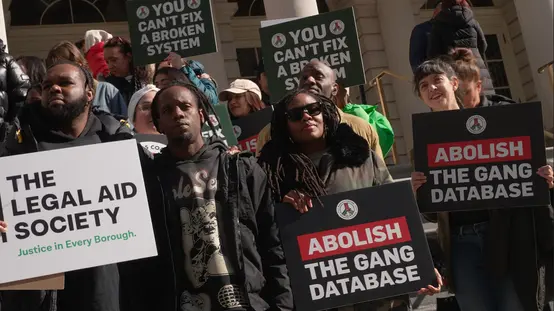
Police departments claim that gang policing is a crucial and precise crime prevention strategy. In reality, gang policing is a racially discriminatory practice that targets thousands of young Black and

Driving While Black: Reimagining Traffic Safety The U.S. has persistently relied on armed law enforcement to enforce traffic laws. However, existing evidence does not support the notion that police traffic

Unchecked and Unruly: How Sheriffs Often Act with Impunity Sheriffs are locally elected officials that operate large law enforcement agencies and jails, and to an increasing extent play a role